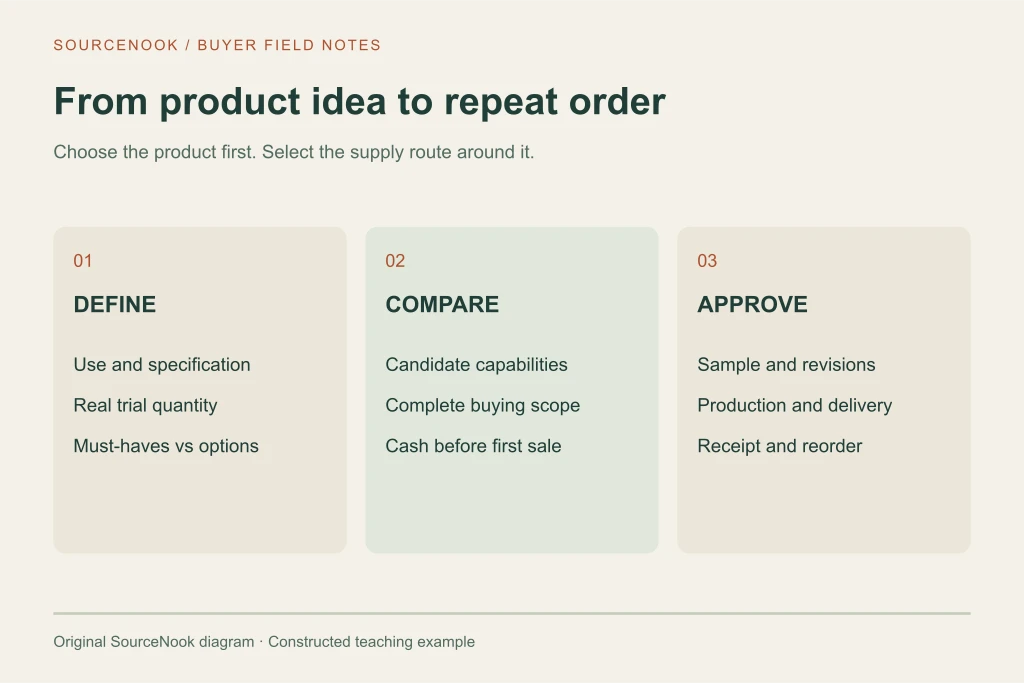
Product sourcing is the work of turning a product requirement into a supplier and an order you can repeat. It includes choosing a buying route, finding candidates, comparing complete offers, checking samples and agreeing how the goods will be delivered. Start with the product and the size of the decision you can afford; choose a country or marketplace after those requirements are clear.
For a small brand, the first useful result is a workable buying plan: what you will receive, what you must spend before selling it, and what would make you stop. A long supplier list becomes useful only when you can compare the businesses on that basis.
Choose a sourcing route that fits the product
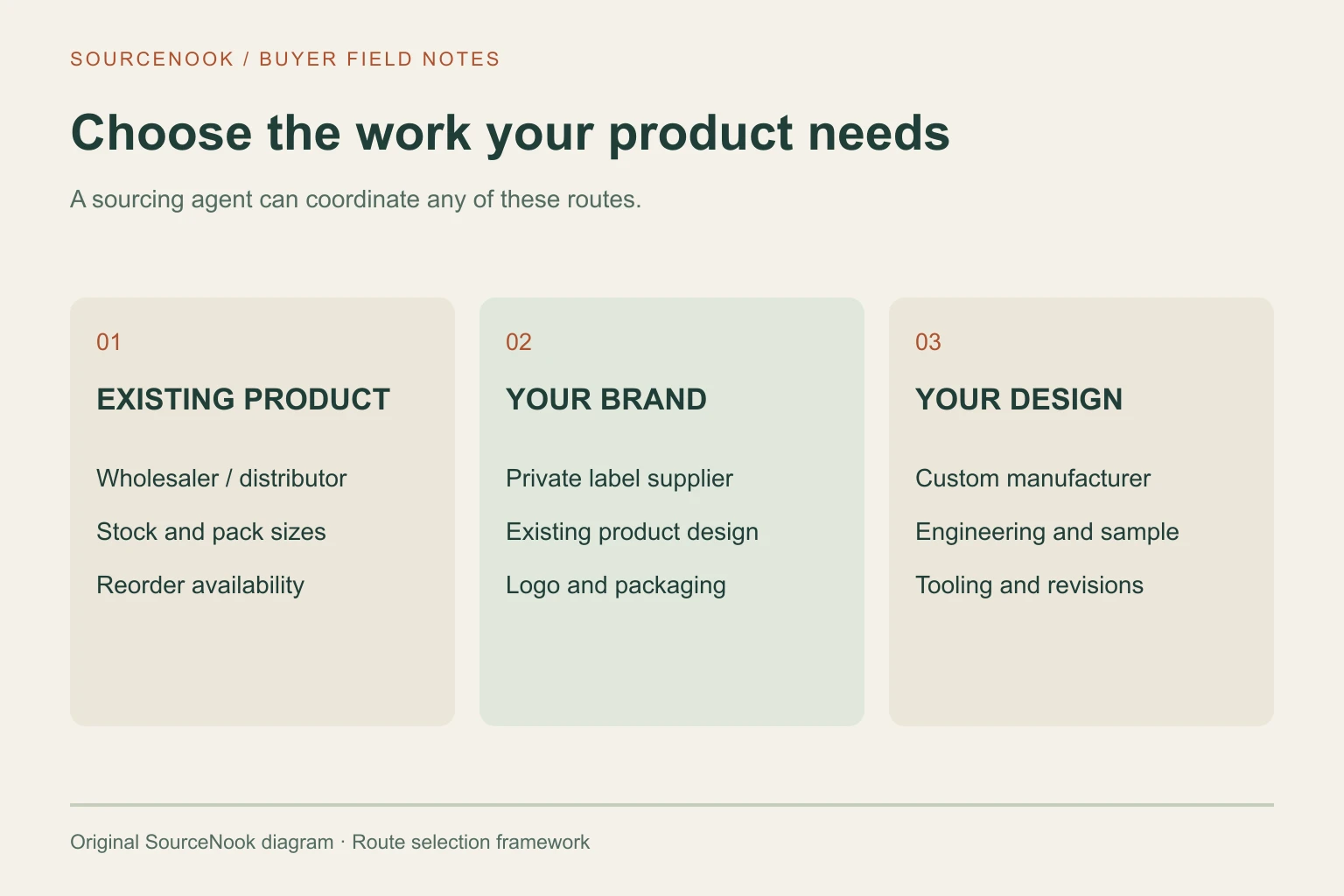
You can buy an existing item from a wholesaler, add your branding to an established product, or commission a manufacturer to make a design. A sourcing agent is another choice about who coordinates the work. An agent can help with several of these routes; hiring one does not determine whether the product is stock, private label or custom.
| Buying route | Good starting situation | Resolve before committing |
|---|---|---|
| Wholesaler or distributor | You want an existing product in a manageable quantity | Resale terms, actual stock, pack sizes and replenishment |
| Private label supplier | An existing design works, but you need your own brand or packaging | Minimums for each change, artwork approval and product documentation |
| Custom manufacturer | Dimensions, construction or performance must change | Engineering, prototypes, tooling and responsibility for revisions |
| Sourcing agent or service | You need someone to perform defined search or coordination tasks | Deliverables, supplier relationships, fees and handover records |
Our starting preference for an untested product is the route that answers the sales question with the fewest irreversible commitments. A stock product with a simple branded sleeve may be a better experiment than a custom mold. Once demand depends on a distinctive feature, development can be the right investment. The OEM and ODM guide helps separate design work from manufacturing work.
Write a product brief before asking for prices
Begin with one product version and one real trial quantity. Separate requirements that determine usability from choices you could change to fit the budget. For a notebook, paper size and page count affect the product; a foil logo may be optional. If both appear as loose preferences, suppliers will quote different items and the cheapest reply will tell you very little.
Here is a brief you can adapt. Replace every bracketed item, attach the relevant drawings or reference photographs, and identify the revision of each attachment.
We are sourcing [product] for [customer/use] in [sales market]. Our initial order is [quantity], split into [variants]. Required specification: [dimensions, material, construction and performance]. Packaging: [individual pack and carton requirements]. Optional changes: [separate list]. Please quote the required version first, identify any substitutions, and price optional work separately. Delivery point: [address or named handover location]. Please state sample scope, production start conditions, exclusions and the operations performed by your company.
Add who will approve the sample and which questions need specialist review. For an electrical product, that may include the intended market’s technical documentation and testing requirements. For a notebook, it may include page count, binding, paper behavior and the approved print file. Defining these checks early keeps a supplier from pricing an easier product than the one you intend to sell.
Build a shortlist across useful channels
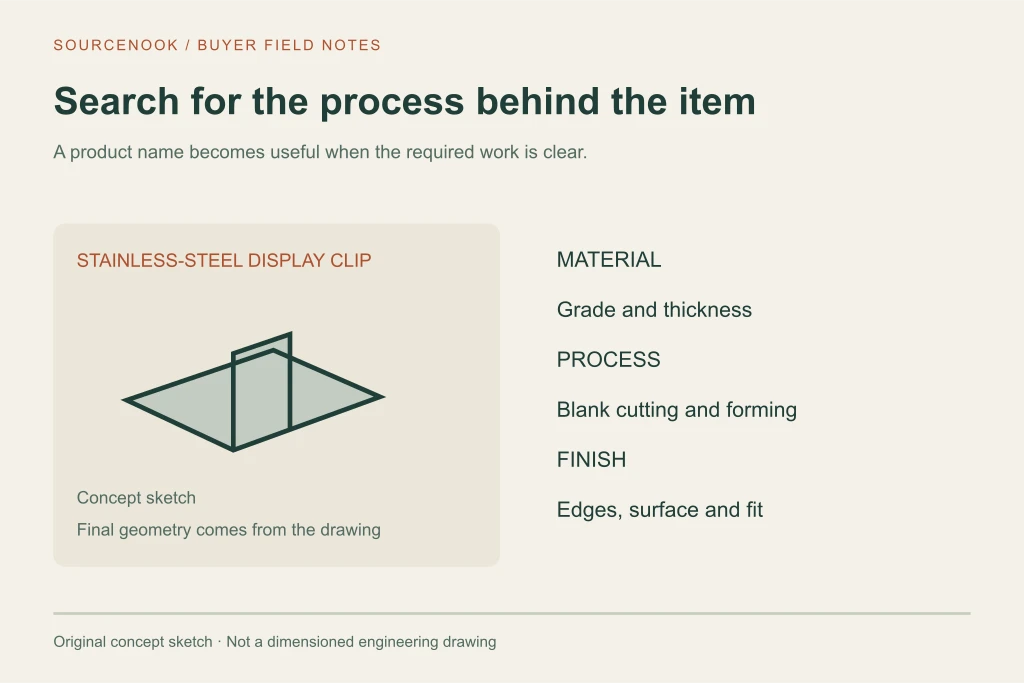
Product sourcing websites, trade-show exhibitor lists, supplier directories and referrals are starting points. Search for a product and its manufacturing process, then narrow by location when shipping, communication, technical capability or a domestic-supply requirement makes location important. For a U.S. manufacturing search, NIST MEP’s Supplier Scouting program connects buyers with domestic manufacturing capabilities through its network.
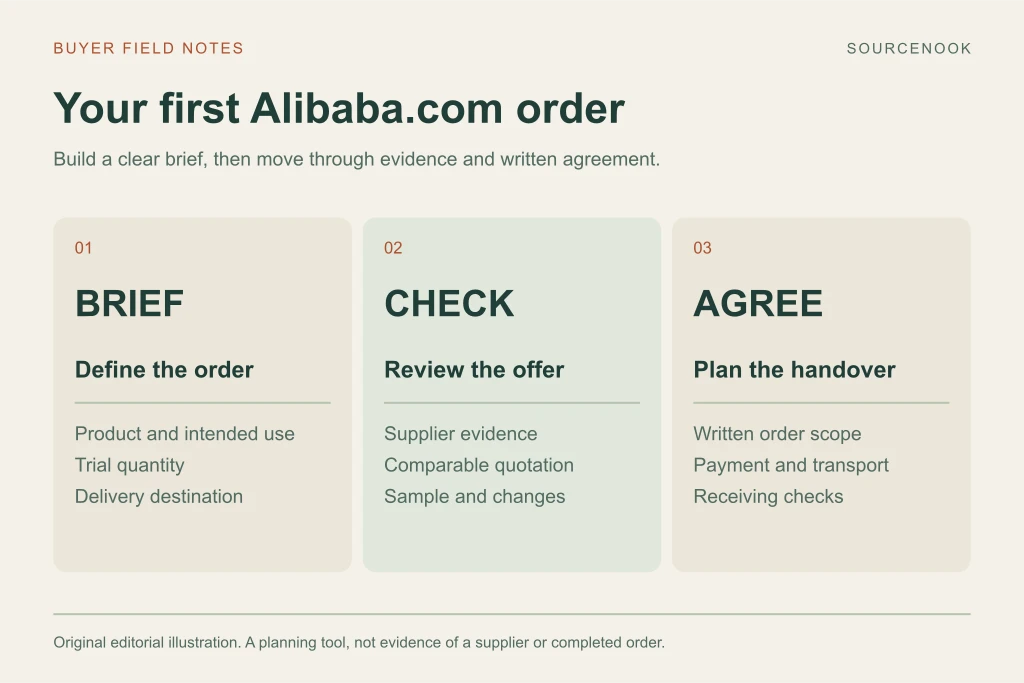
Alibaba.com can provide an international marketplace route; our first Alibaba order guide explains the buying process. If 1688 is an option, compare the extra coordination with the proposed saving using the 1688 versus Alibaba comparison. Keep the same product brief across channels.
Shortlist businesses that can explain how they would supply this order. A useful reply identifies the product, quantity, process and open questions. An attractive catalog with no answer about your required material is still a discovery lead. The manufacturer search guide shows how to turn that lead into a candidate worth sampling.
A lower unit price can consume your trial budget
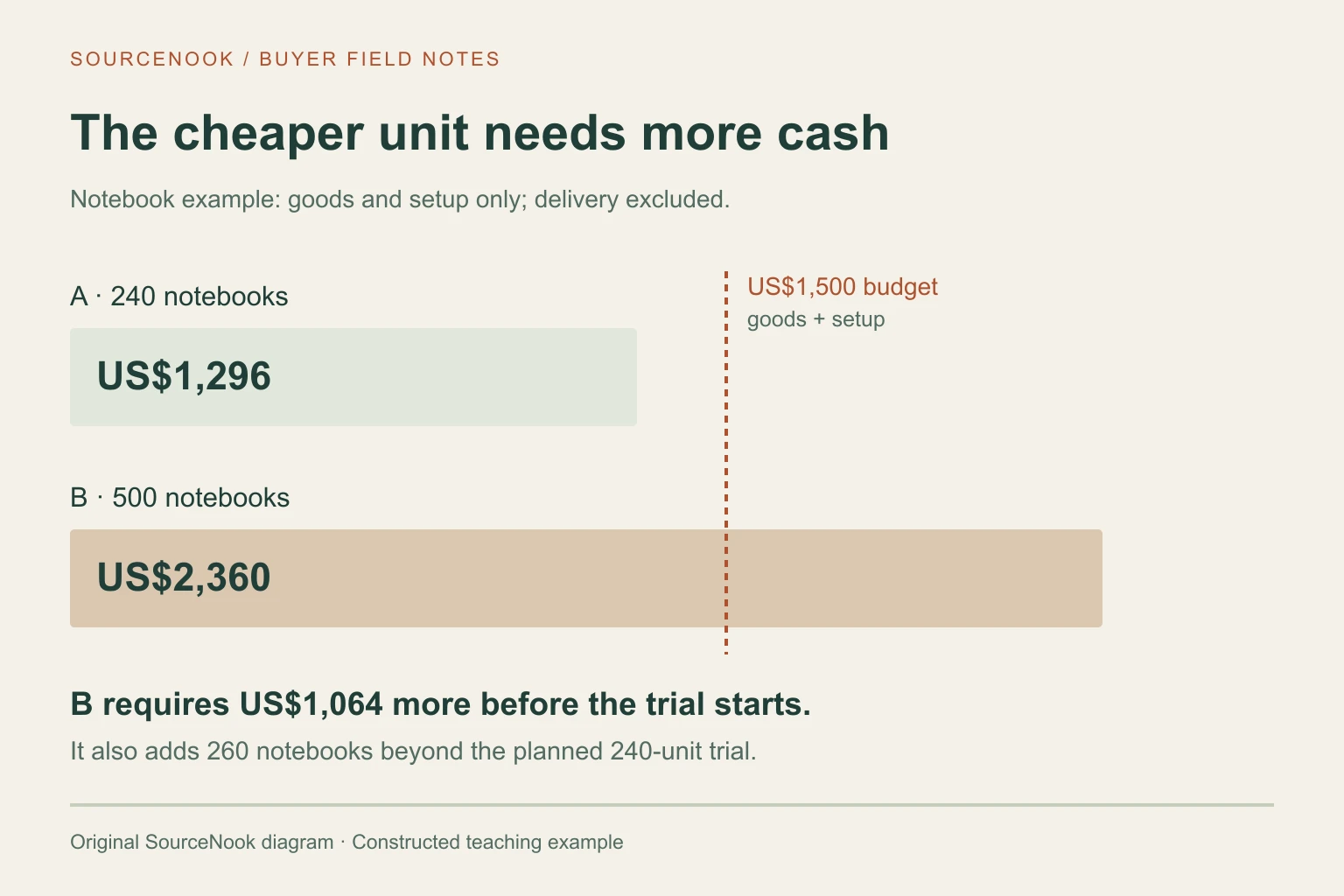
Example. You plan to test 240 A5 notebooks. Both offers meet the same agreed paper, page-count and packaging specification. Offer A supplies 240 at US$5.20 each plus US$48 for artwork setup. Offer B requires 500 at US$4.40 each plus US$160 setup. These subtotals cover goods, the specified packaging and setup; transport, duties and taxes still need separate quotes.
| Comparison | Offer A | Offer B |
|---|---|---|
| Order quantity | 240 notebooks | 500 notebooks |
| Goods | 240 × US$5.20 = US$1,248 | 500 × US$4.40 = US$2,200 |
| Setup | US$48 | US$160 |
| Goods and setup subtotal | US$1,296 | US$2,360 |
| Subtotal per ordered notebook | US$5.40 | US$4.72 |
| Quantity beyond the planned trial | 0 | 260 |
B reduces the goods price by US$0.80 per notebook, but requires US$1,064 more cash before the experiment starts. If your goods-and-setup budget is US$1,500, A leaves US$204 within that budget and B exceeds it by US$860. Neither figure includes the separate delivery budget. The additional 260 notebooks are inventory, not an immediate loss; they become useful if you can sell them without an expensive delay or product revision.
For this trial, we would choose A unless there is a specific reason to commit to the extra stock. The decision changes when repeat demand is supported and the larger order fits the cash plan. Keep that reason beside the comparison instead of accepting a lower unit price as sufficient evidence. For minimums split by color or packaging, see the MOQ comparison examples.
Put samples, approval and delivery into the buying plan
A sample should answer the question holding up the order. A notebook construction sample can help assess binding and paper; a separate print proof may still be needed for the final artwork. Record what was reviewed, what passed and what remains open. Give the supplier one approved reference version and a clear way to request changes.
Compare the delivery scope alongside the product offer. ICC’s Incoterms rules address delivery tasks, costs and risk between buyer and seller. Where a rule is used, record the rule, named place or port and version, then obtain the actual transport quote. Agree payment milestones and acceptance criteria separately. The shipping-cost guide demonstrates how missing collection or destination charges change a comparison.
Set the next decision before releasing each commitment: approve a defined sample, confirm the production specification, review the agreed pre-shipment evidence, then reconcile the received quantities and variants. If a production change affects the feature you tested, reopen that approval. Reusing an old approval after a material substitution defeats the purpose of sampling.
Keep a sourcing record you can use for a reorder
Save the supplier’s legal name, quote revision, specification, approved sample reference, open issues and delivery arrangement together. After receipt, add actual quantities, defects, corrective actions and the costs you paid. These records turn a one-off purchase into a comparison for the next order.
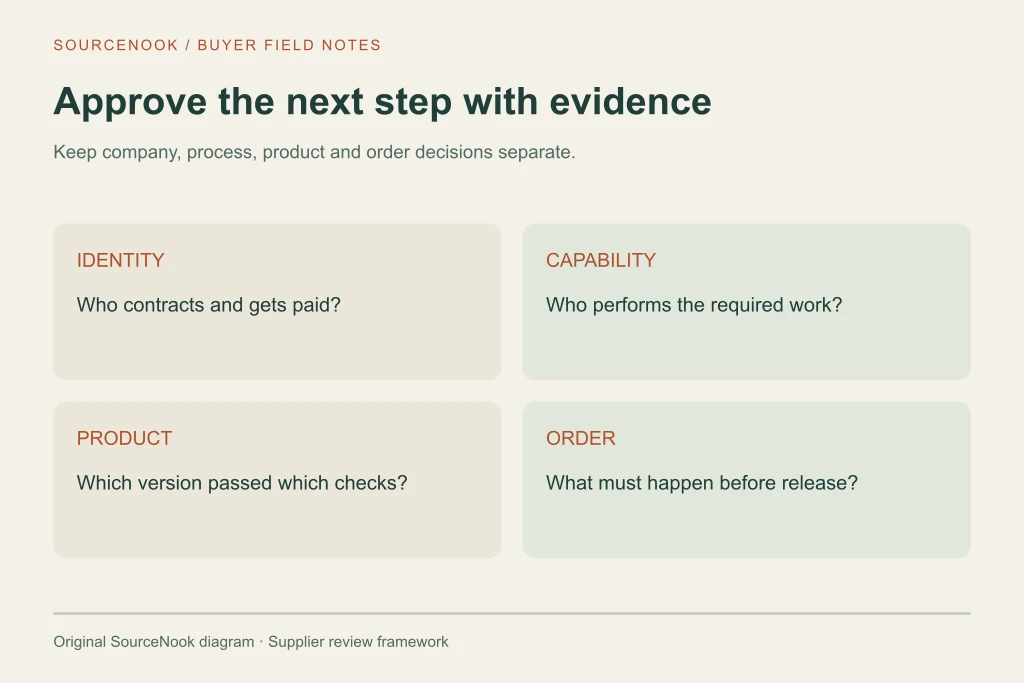
If following up on all of this is the bottleneck, use the sourcing agent selection guide to define the work you want delegated. If the uncertainty is about a candidate’s capability, use the supplier vetting checklist before paying for further development.
Frequently asked questions
Do I need a sourcing agent for my first product?
You can manage a straightforward order directly if you can write the brief, evaluate replies and coordinate approvals. Consider an agent when specific tasks exceed your time, language or local coordination capacity. Compare the fee with those deliverables rather than assuming an agent is required for every overseas order.
Should I source locally or overseas?
Compare candidates against the same specification, order size, delivery scope and development needs. A nearby supplier may simplify visits and revisions; another location may offer a better process match. Choose from comparable offers and the work each route creates, rather than country-level assumptions about price or quality.
Is product sourcing the same as dropshipping?
Product sourcing covers finding and qualifying the supply. Dropshipping describes an arrangement in which a supplier fulfills orders directly to the end customer. If that is your intended model, add per-order fulfillment, stock updates, packaging and returns to the supplier brief.
Method. The notebook prices, budget and buying decisions are constructed examples, not supplier quotations or completed SourceNook orders. Linked primary sources support the named programs and trade-term context; the buying workflow is our editorial recommendation. Reviewed September 16, 2026.