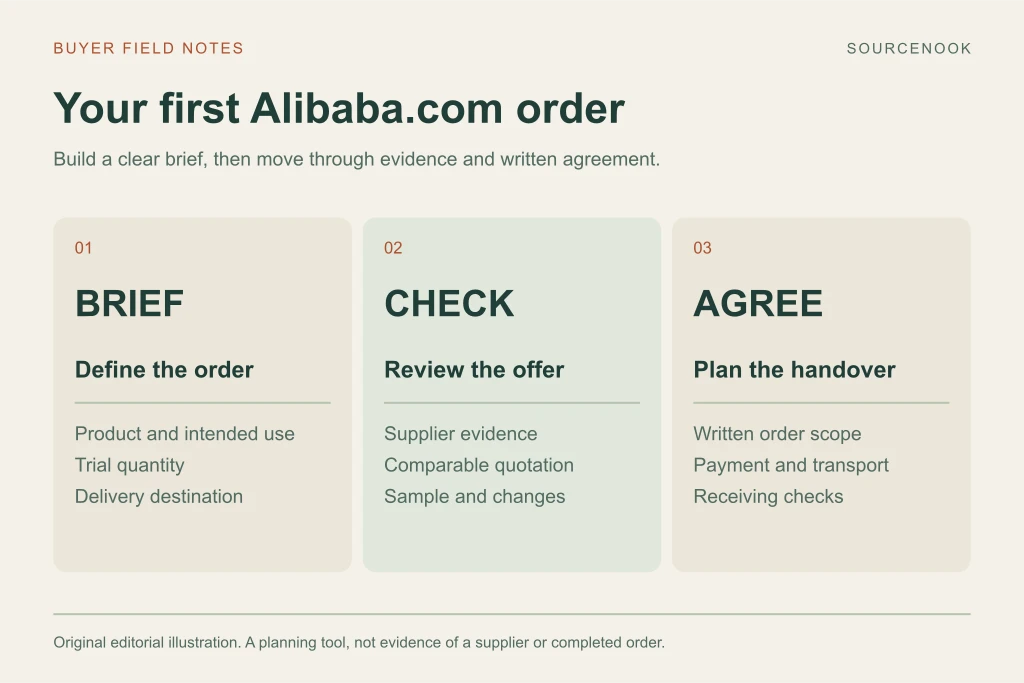
To buy from Alibaba, prepare a product brief, compare itemized quotes, approve a sample, and agree payment and shipping terms before placing your production order. This guide walks through each step, with a quote comparison and a checklist you can use for your first order.
For a first business order, choose a product you can describe and inspect clearly. Keep the initial range narrow, compare the total cost of the same specification, and agree what must happen before each payment becomes due.
1. Turn your product idea into a brief
Example: a retailer wants 120 cotton fabric organizers in one natural color, with paper sleeves and a one-color logo. The finished size is 30 × 20 × 15 cm. The buyer asks for the standard version and the branded version separately, so the cost of customization stays visible.
Put the product reference, material, dimensions, quantity, logo, packaging, destination and desired arrival date into a one-page brief. Give it a version number. Keep a supplier’s proposed fabric or size change in a separate column until you decide whether it is acceptable.
If the minimum exceeds your trial quantity, identify the constraint first. Reducing colors or using standard packaging may help; extra units also tie up cash. The MOQ cost comparison shows how a cheaper unit price can produce a more expensive first order.
2. Find suppliers, then check the company behind each quote
Search for a product plus a meaningful specification, such as “cotton fabric organizer custom logo.” Save the listing, variant, company name and contact together. Start with three relevant candidates so you can compare their replies side by side. Alibaba.com’s buyer workflow also explains the RFQ route for sending a defined requirement to suppliers.
Check the company, factory address and product scope in the supplier’s assessment report. When those details match the proposed order, move on to product evaluation. If the quote names a different business or the report covers another factory, resolve the mismatch first. Ask which company will manufacture, contract and receive payment; record the explanation against the documents.
A useful reply identifies the production location and provides relevant documents. If the supplier repeatedly avoids the identity question, move to another candidate. Use the supplier verification checklist to record the result.
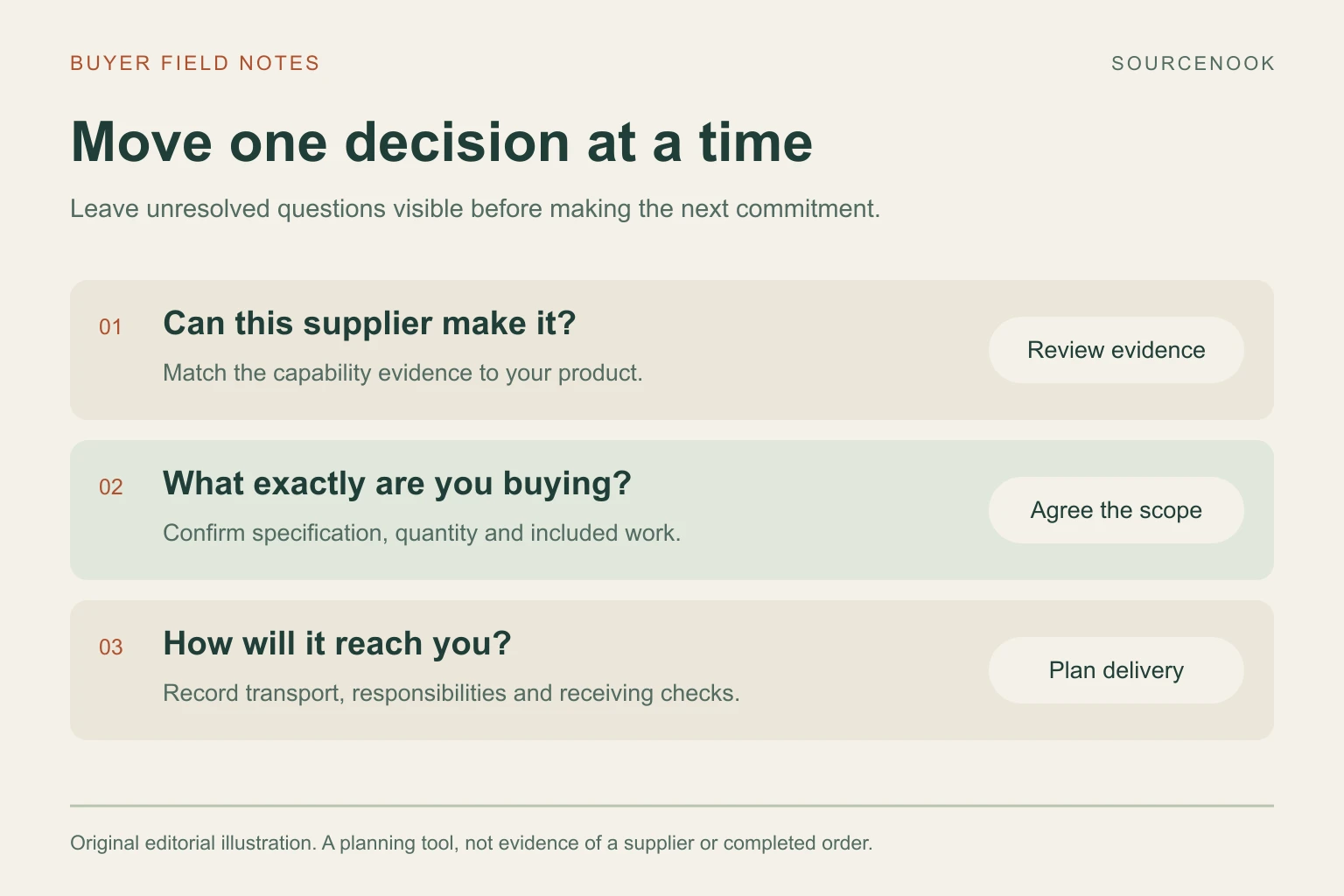
3. Compare the full quote, not just the unit price
Send every candidate the same brief and request separate lines for goods, logo setup, packaging, samples and delivery. Keep a blank charge marked “unquoted” until the supplier confirms it is included or prices it separately.
| Cost item | Supplier A | Supplier B |
|---|---|---|
| Unit price | $4.50 | $5.00 |
| Goods subtotal | 120 × $4.50 = $540 | 120 × $5.00 = $600 |
| Logo setup | $60 | Included |
| Paper sleeves and cartons | Unquoted at first; $36 after clarification | Included |
| Confirmed production subtotal | $636 | $600 |
| Samples, freight and destination charges | Separate; still to be quoted | Separate; still to be quoted |
Supplier A initially looks cheaper, but its completed production quote is $36 higher. Supplier B is the lower production-cost option for this specification. Compare sample results, delivery scope and supplier checks before choosing the order. The Alibaba inquiry template includes a filled request and a follow-up for missing charges.
We would resolve any missing charge that could change the choice before committing to the first order. Here, packaging turns the apparent US$600 tie into US$636 versus US$600. Ask whether each blank item is included or separately charged, then compare completed offers at the same delivery point. Keep a price still awaiting confirmation visible in the budget.
4. Approve a sample against written acceptance criteria
For the organizer, check dimensions, seams, material, color and packaging. Add logo position and print quality for the branded version. Photograph issues and identify the sample version in your notes.
A stock sample can help you choose a fabric or construction. Approve final branding against a sample that includes it. Record each item as pass, revise or not yet checked; a missing logo stays pending even when dimensions pass. The sample review worksheet provides a filled record to adapt.
A different product: a mains-powered LED desk lamp for EU sale
Add a document review before committing to production. Request the EU Declaration of Conformity for the exact model, check the manufacturer’s identity and signature, and identify the legislation and standards listed. The EU’s declaration of conformity guidance explains those fields.
Compare the product identification across the quotation, sample and documents. Record the rated input, plug, power supply and intended sales country. Keep mismatches pending and have a qualified product-compliance specialist review the applicable requirements before placing the product on the market. The worked model-and-document check shows how to record and resolve a mismatch. Separately, review the sample’s light output, controls, finish and packaging.
5. Name the shipping term and the delivery location
A price described as “shipping included” still needs an agreed handover point. ICC’s Incoterms® 2020 rules allocate delivery obligations, transport costs and risk between buyer and seller. Write the rule, named place or port, and version into the quotation.
| Term | Delivery and responsibility | What to resolve in your quote |
|---|---|---|
| EXW — Ex Works | Seller makes goods available at the named place, without loading the collecting vehicle. Buyer arranges collection and export/import clearance. | Who can handle loading and export clearance for you? |
| FCA — Free Carrier | Seller clears export and delivers to your nominated carrier/person. At the seller’s premises, delivery includes loading; at another named place, goods arrive ready for unloading. | Give the precise handover location. Buyer arranges onward carriage and import clearance. |
| FOB — Free on Board | For sea or inland waterway transport. Seller clears export and delivers on board the vessel at the named shipment port, where risk transfers. | Name the port. Buyer arranges onward freight and import clearance. |
| DDP — Delivered Duty Paid | Seller arranges carriage and export/import clearance, including applicable duties and taxes, to the named destination. Goods are delivered ready for unloading. | Confirm the seller’s import-clearance arrangement, exact address and unloading plan. |
For containerized or multimodal shipments handed to a carrier before vessel loading, discuss FCA with your forwarder; ICC Academy explains the FCA and FOB distinction. Its EXW and FCA comparison covers collection and export clearance. For DDP, resolve who will carry out import formalities before accepting the offer; the DAP and DDP comparison explains why this can be difficult for a foreign seller.
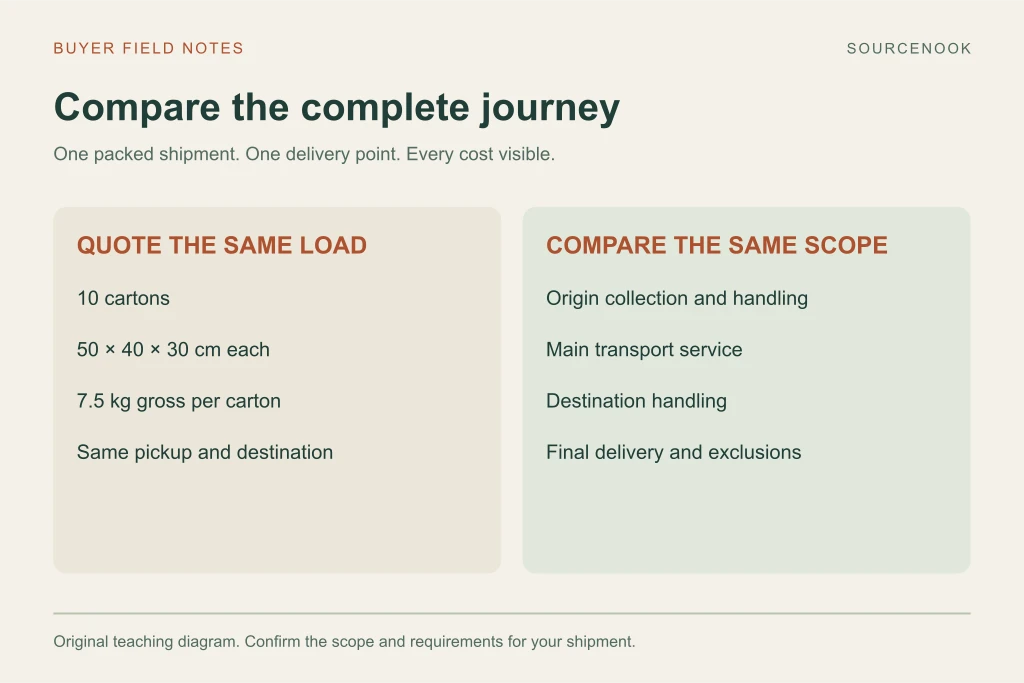
Request carton counts, external dimensions and gross weights for the freight quote. Our net, gross and chargeable weight example shows how the same carton can be billed differently under different services.
Price the whole journey before choosing a shipping option. Our Alibaba shipping-cost comparison shows how a lower main-freight charge can become a higher delivered transport bill once the missing services are included.
6. Agree payment milestones and a usable schedule
Negotiate payment amounts together with the events that make them due. For a made-to-order product, propose a production payment after specification approval, and a balance milestone linked to completion and the agreed inspection result before dispatch. Ask what happens if inspection requires rework, and put the agreed answer in the order.
Compare offers by the cash committed before each check and the evidence received before the next payment. If a supplier requests the full production price before a sample or specifications are settled, propose a smaller sample stage first. If you cannot agree workable checkpoints, use another candidate. The U.S. International Trade Administration’s payment-method overview explains how payment timing shifts risk between buyer and seller.
For a Trade Assurance order, use the payment instructions shown for that order and keep the specification and delivery commitments in its record. Consult Alibaba.com’s protection terms when choosing the payment route. If bank details or the beneficiary change, pause payment and verify the change through an established contact channel.
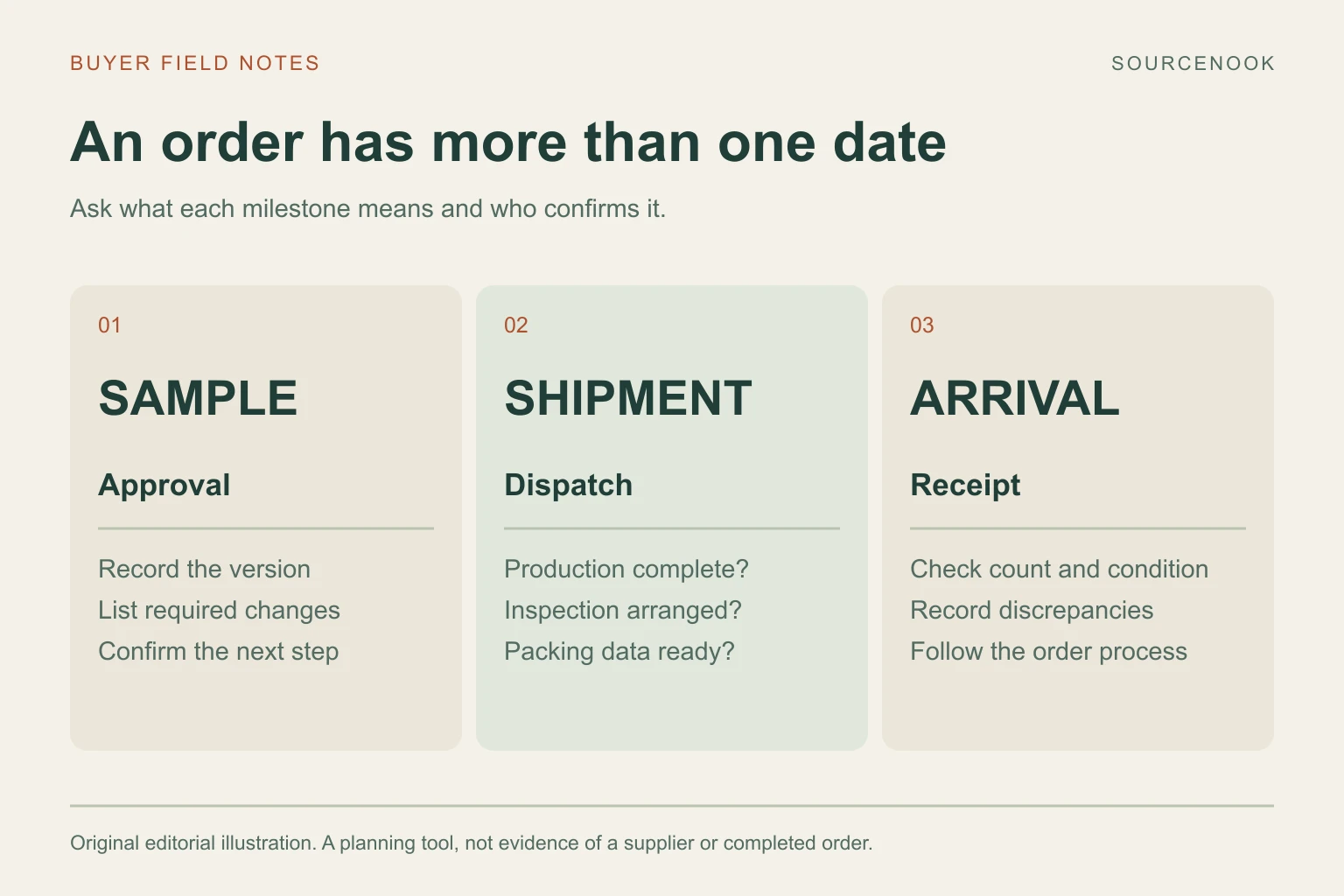
Build the schedule from dated milestones: sample dispatch, sample approval, production start, goods ready for inspection, dispatch and expected arrival. For each lead time, confirm the start event, whether it uses working or calendar days, and which approvals or materials must already be ready.
A reply saying “production after sample approval and deposit receipt” gives you a starting condition; “fast delivery” gives you none. Ask the first supplier for a dated goods-ready milestone and the second for both the starting condition and completion milestone. If goods will be ready too late for inspection and transport before your launch, reduce customization, move the launch date or choose a supplier with a workable schedule.
7. Receive the order and close the loop
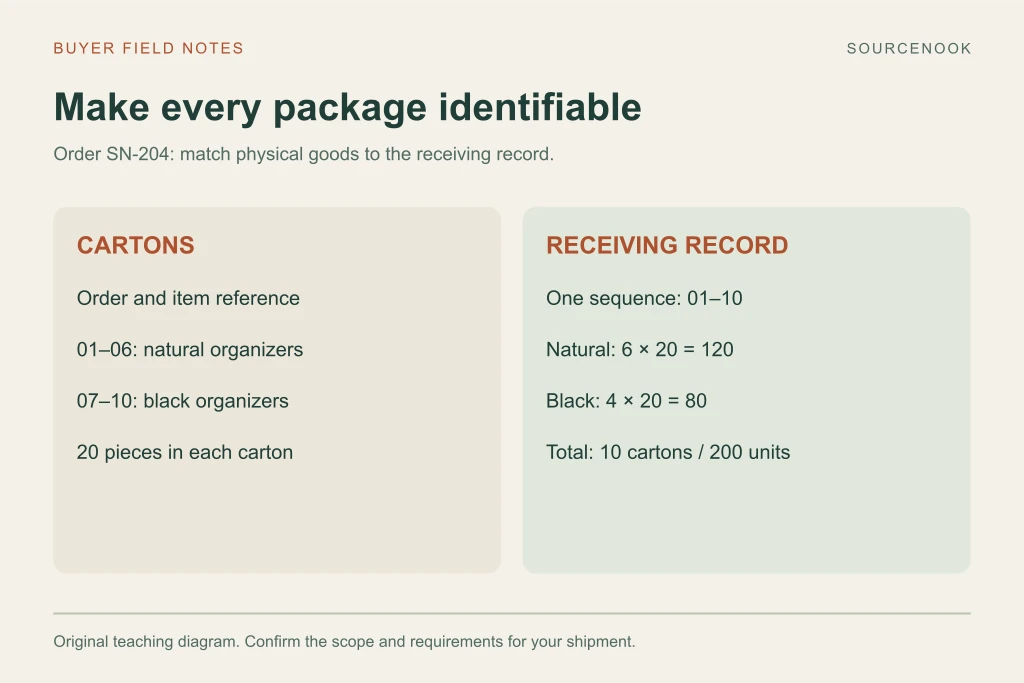
Before dispatch, agree carton numbers and shipping marks that match the packing list. On receipt, check both the number of cartons and their item or color breakdown; the right carton count can still conceal a variant mismatch.
Arrange a receiving contact before dispatch. Reconcile carton and unit counts with the packing list, photograph damage, and compare the goods with the approved specification. Send a discrepancy record identifying the order, affected quantity and supporting photographs through the agreed channel. Keep it with the sample notes so your next order starts from documented results.
Frequently asked questions
Why is Alibaba so cheap in some listings?
The displayed price may apply to a high quantity tier, a standard version or goods without delivery. Select your actual variant and quantity, then compare the itemized production subtotal and delivery scope. Treat the listing price as the starting point for a quote.
Why is Alibaba shipping so expensive compared with the item price?
A sample order spreads transport charges across very few units, while bulky packaging can increase chargeable weight. Check the packed dimensions, service and destination. Request a second freight quote using exactly those inputs before deciding whether the first is expensive.
Can I buy one item before ordering in bulk?
Yes, when the supplier offers a single stock item or sample. Ask for that option separately from the production quote. Confirm which material, construction and customization you can review, and keep untested requirements pending.
Should I use 1688 instead?
Start with Alibaba.com if you want an international buying workflow. Consider 1688 when you can arrange domestic payment, communication, collection and export steps. Compare the full route in our 1688 vs Alibaba guide.
Method. The product scenarios, prices and calculations are constructed teaching examples, not supplier quotations or completed SourceNook orders; the diagrams are original explanatory illustrations. Reviewed September 16, 2026.