Shipping marks identify cartons or other cargo units so the shipment can be matched to its paperwork and delivered to the right receiver. Start with a reference that connects each carton to an order and packing-list row. For palletized goods, identify the pallet as well as the cartons it contains.
A useful mark answers three questions at receiving: which order is this, which package is it, and what should be inside? We recommend solving those questions before adding decorative branding. A clear carton number is more useful to a warehouse than a large logo with no link to the packing list.
What are shipping marks?
They are agreed identifiers placed on cargo or packaging and reflected in shipment records. Maersk describes its Marks and Numbers field as a way to distinguish cargo pieces for identification and handover. That particular field is optional in Maersk’s instructions; your buyer, forwarder and receiving warehouse may have their own marking requirements.
Keep three things distinct: a carton mark identifies the goods; a carrier shipping label routes and tracks the consignment; handling or regulated labels communicate their own requirements. Make room for each approved label. A generic carton mark is not a replacement for a carrier label, a required product label or a dangerous-goods marking.
A carton shipping mark you can adapt
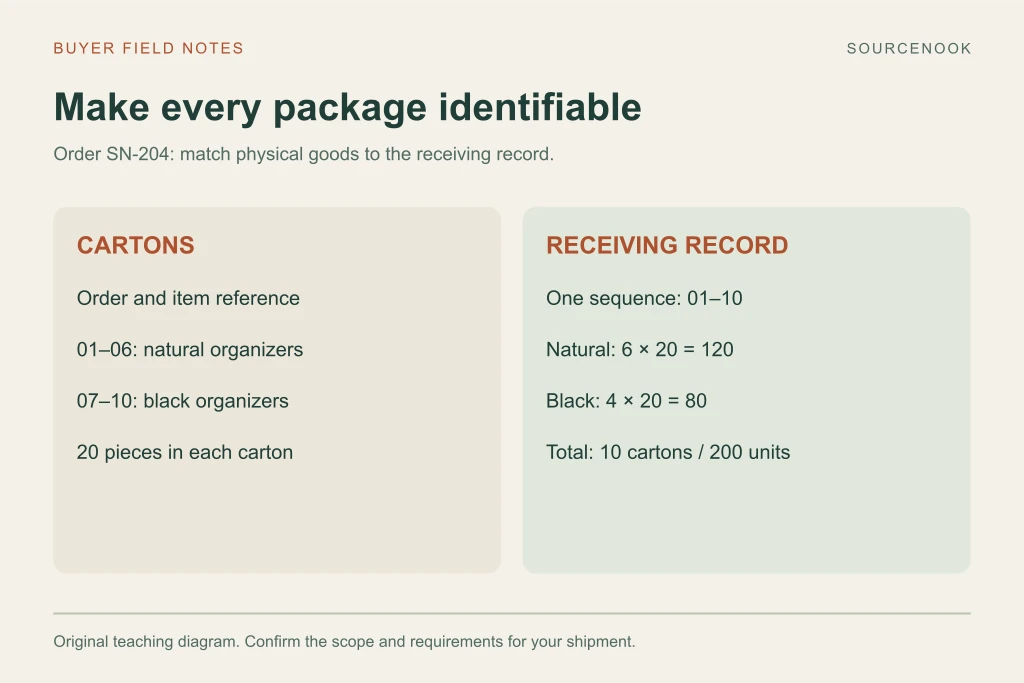
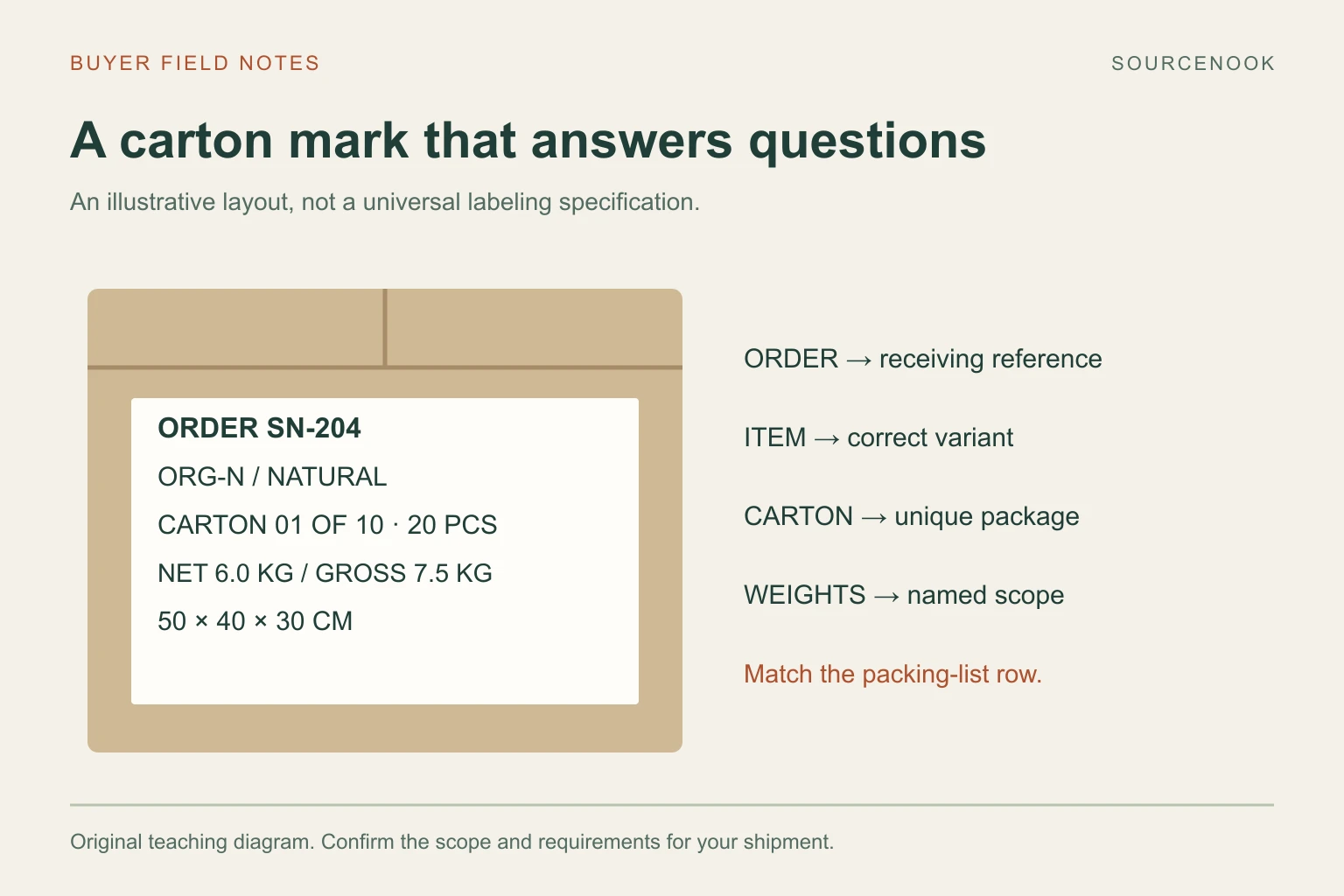
Example. Order SN-204 contains 200 cotton organizers: 120 natural and 80 black, packed 20 per carton. There are ten cartons. The buyer and supplier agree to number the natural cartons 01–06 and the black cartons 07–10.
ORDER: SN-204
RECEIVER REFERENCE: [agreed receiving reference]
ITEM / VARIANT: ORG-N / Natural
CARTON: 01 OF 10
QUANTITY: 20 PCS
NET / GROSS: 6.0 / 7.5 KG
OUTER SIZE: 50 × 40 × 30 CM
This is a filled teaching example, not a universal label specification. Decide which fields belong on your cartons with the receiver. Use the actual measured packing data, and put any required origin statement or other mandated information through the applicable destination checks rather than guessing it from this example.
| Field | Purpose | Check before printing |
|---|---|---|
| Order or receiving reference | Connects cargo to the buyer’s expected delivery | The warehouse recognizes SN-204 or its own required reference |
| Item and variant | Distinguishes natural from black organizers | ORG-N and ORG-B match the approved product and packing records |
| Carton number | Identifies one package within the shipment | The ten-carton sequence has no missing or repeated number |
| Quantity | Shows the expected contents of that carton | A part-filled carton has its own actual quantity |
| Weights and outer size | Describes the packed unit when those fields are requested | Units, packaging scope and measurements match the final carton |
Make the packing list agree with the carton numbers
The packing list provides the shipment breakdown behind the marks. The U.S. International Trade Administration lists quantities, package counts, net/gross weights and package marks among the fields in an export packing list, and distinguishes it from a commercial invoice in its export-document guide. Use this as background on the document’s purpose, then confirm the document requirements for your particular shipment.
| Cartons / contents | Quantity calculation | Net / gross weight |
|---|---|---|
| 01–06: ORG-N, natural | 6 cartons × 20 = 120 units | 36 / 45 kg |
| 07–10: ORG-B, black | 4 cartons × 20 = 80 units | 24 / 30 kg |
| Shipment, before pallets | 10 cartons; 200 units | 60 / 75 kg |
Here each organizer weighs 0.30 kg and each carton adds 1.50 kg of packaging. The 200 products weigh 60 kg net; ten packed cartons weigh 75 kg gross. If pallets are added, record their weight and outer dimensions separately before quoting the palletized shipment. The net and gross weight guide shows how to keep those measurement boundaries consistent.
Now suppose the label for carton 07 is accidentally printed as ORG-N. Counting ten cartons still gives the expected total, but the declared mix becomes 140 natural and 60 black. The mismatch affects 20 units in each variant even though nothing is physically missing. Compare the label with the contents and correct the source of the error before dispatch; changing paperwork to match an incorrect label would hide the problem.
Shipping marks for a pallet: keep both identification levels
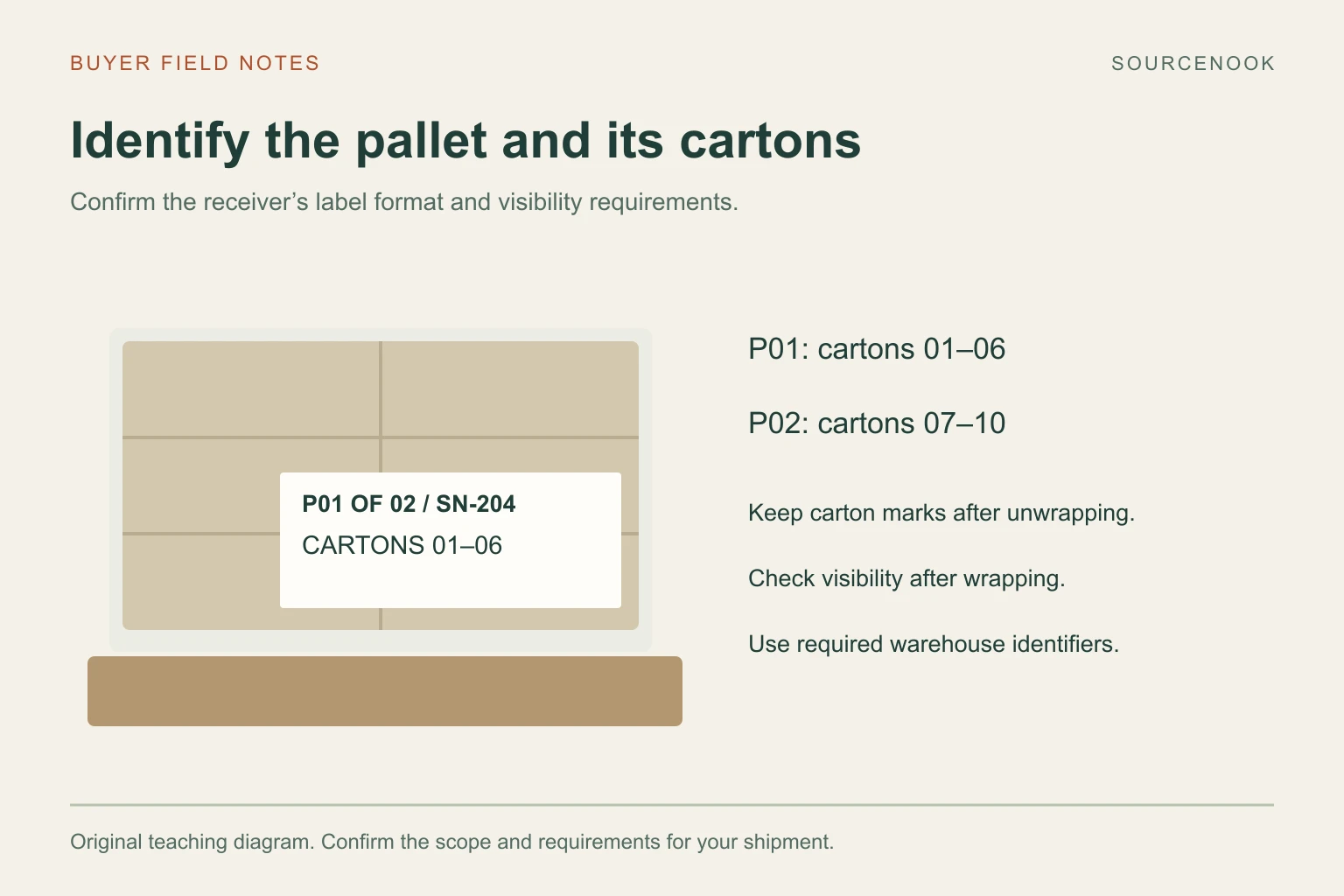
Suppose the example shipment uses two pallets: P01 carries cartons 01–06 and P02 carries cartons 07–10. A pallet reference of “P01 OF 02 / SN-204 / CARTONS 01–06” connects the handling unit to the carton sequence. After a warehouse removes the wrap, the individual carton marks still identify the goods.
Ask the receiving warehouse and forwarder for their label specification, including whether they require a barcode identifier and which faces must be readable. Use their actual barcode format and issued identifiers when required. The diagram below illustrates grouping and label visibility; it does not supply a working barcode or prescribe a universal label position.
Review the pallet as it will actually travel: wrapping, straps and neighboring cartons can cover a label that was visible on the packing bench. Request a photo after wrapping, showing the identifier and overall pallet. Keep handling instructions separate and readable. If a partial pallet is split for onward delivery, update the record of which carton numbers travel with each handling unit.
Approve the artwork and the packed result
- Agree the receiving requirements. Obtain the order reference, required fields, numbering convention and any warehouse label specification before artwork is prepared.
- Review one label for each variant. Read the reference, product code, quantity and units. Include a part-filled carton if the order has one.
- Reconcile the sequence. Add the row quantities, count the packages and compare the variant totals with the approved order.
- Check final placement. Review photos of representative packed cartons and wrapped pallets, with labels readable and carrier-label space available.
- Save the final version. Keep the approved artwork, packing list and dispatch photos together. Identify which version supersedes an earlier draft.
Proceed when the physical marks and packing breakdown agree. Clarify a missing receiving reference or unclear warehouse format. Hold the affected cartons when labels duplicate a number, name the wrong variant or contradict the contents. Resolve the physical identification before approving dispatch.
For a first order, include marking work in the supplier inquiry and packaging brief. Have the supplier price any requested label production or repacking so it stays visible in the complete shipping-cost comparison. Use the sample review process to agree a packaging reference before the batch is packed.
Frequently asked questions
Are shipping marks the same as shipping labels?
They serve different jobs. The order, item and carton references connect goods to the buyer’s records. A carrier label provides the carrier’s routing and tracking information. Follow the relevant instructions for both instead of copying a tracking number into every carton field.
Can every carton have the same shipping mark?
Shared fields such as the order reference can repeat. In the numbered system used here, each carton needs its own number so a missing or wrong carton can be identified. Agree the actual identification scheme with the receiver, especially for mixed products and partial cartons.
Should I copy the carton weight onto the pallet label?
Use the weight of the scope named on the label. A pallet’s packed gross weight includes its cartons and pallet-related packaging. Copying one carton’s weight onto a pallet record would describe the wrong handling unit.
Method. Order SN-204, label layouts, packing figures and mismatch scenarios are original constructed teaching examples. Confirm the receiver’s and carrier’s requirements for the actual shipment. Reviewed September 16, 2026.