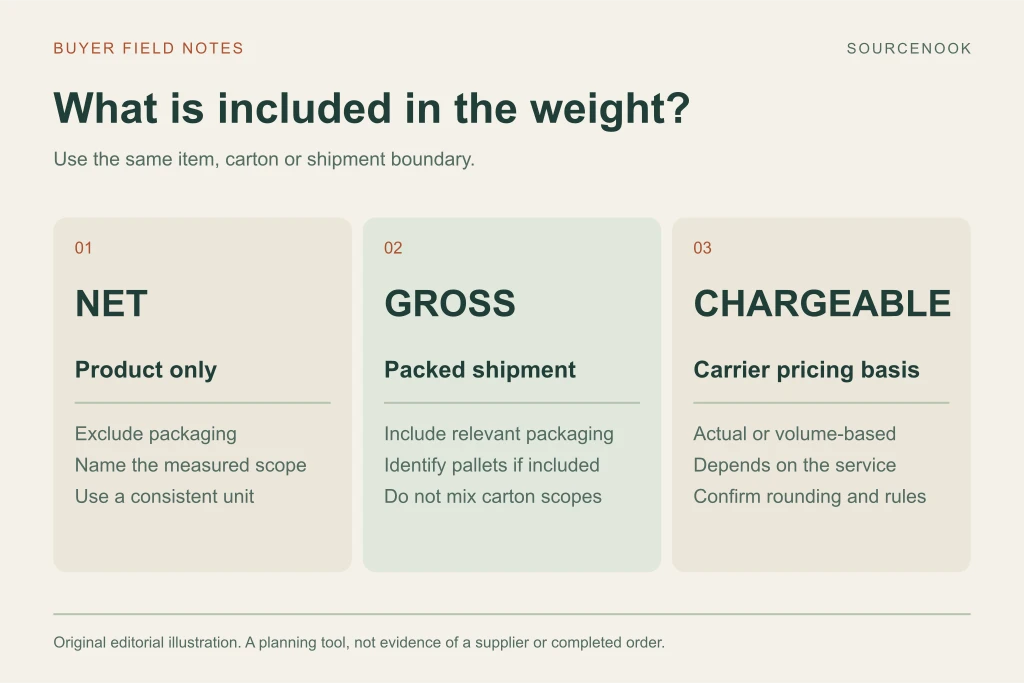
Net weight describes the goods without the packaging included in the stated measurement. Gross weight includes the goods and that packaging. Before comparing the numbers, ask whether each refers to one item, one carton or the entire shipment. A correct number with an unclear basis is still hard to use.
For an overseas buyer requesting a transport quote from a Chinese supplier, the most useful starting information is the package count, external package dimensions and packed weight of each package type. A product listing’s net weight is not a substitute for those shipment details.
Gross vs net weight: the formulas and abbreviations
For the same item or shipment boundary, gross weight = net goods weight + packaging weight, and net goods weight = gross weight − packaging weight. Do not subtract packaging for a full shipment from the gross weight of just one carton.
On a packing record, “net wt” or “N.W.” commonly labels net weight, while “gross wt” or “G.W.” labels gross weight. Write out the terms and units when sending the record to a new contact. Net wt and gross wt are not two charges to add together, and neither is automatically the carrier’s chargeable weight.
Keep three measurements separate
Physical weight measures mass. Volume describes the space occupied. Dimensional or volumetric weight converts package dimensions into a weight-like charging basis using a service-specific rule. It is not an additional physical object you can put on a scale.
| Term | Meaning in the stated scope | Question to confirm |
|---|---|---|
| Net weight | Weight of the goods excluding specified packaging | Is this per item, carton or shipment? |
| Packaging or tare weight | Weight of packaging or containers in that scope | Are inner packs, cartons and pallets included? |
| Gross weight | Goods plus the packaging included in the measurement | Is this the final packed weight? |
| Volume | Space occupied by the external package dimensions | Were the outside dimensions measured after packing? |
| Chargeable weight | The weight basis used by the selected transport service | Which divisor, rounding and minimum rules apply? |
A carton example you can check
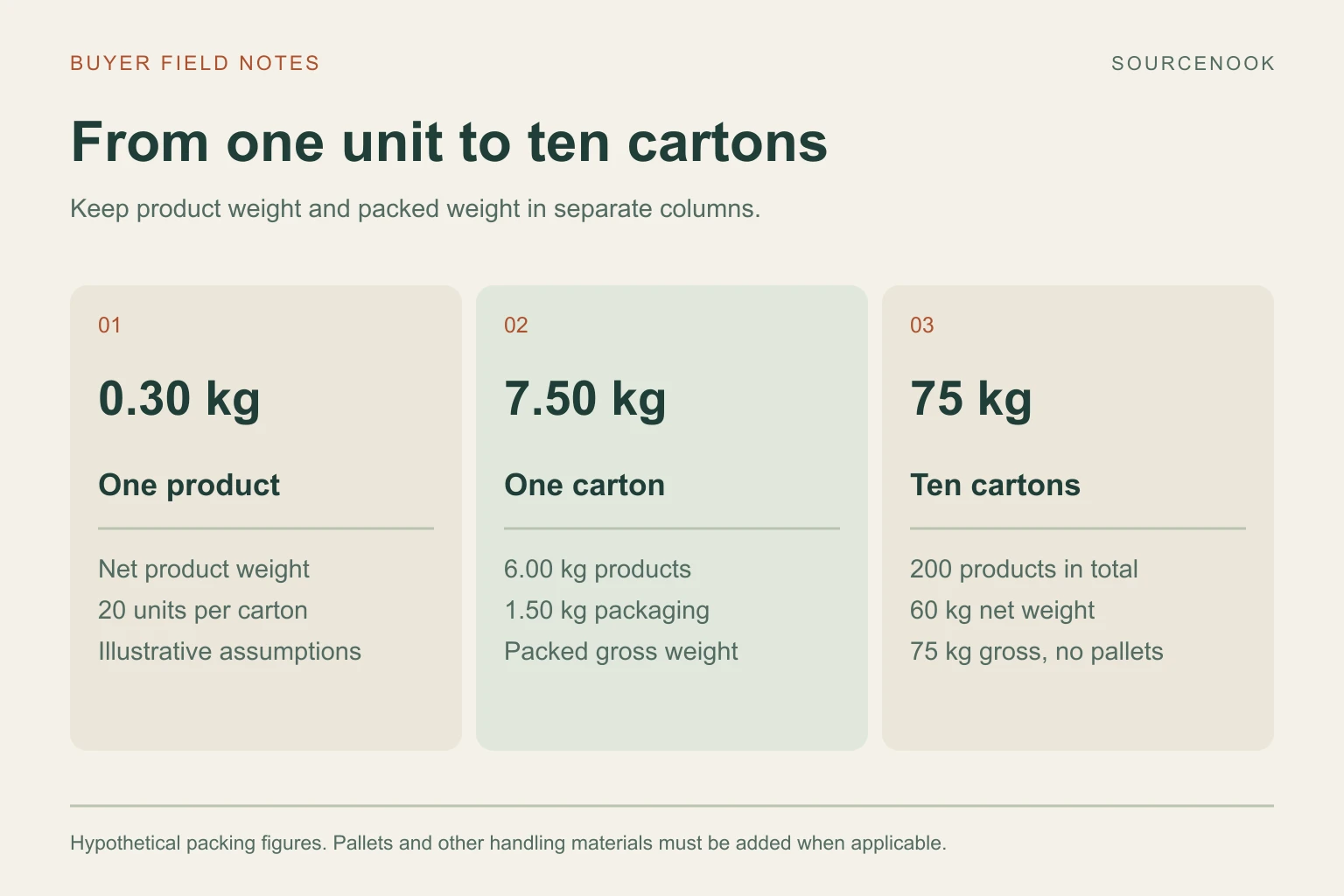
Example. A carton contains 20 organizers. Each organizer weighs 0.30 kg without its packaging. The combined sleeves, protective material and carton weigh 1.50 kg. There is no pallet in this example.
The goods weigh 20 × 0.30 = 6.00 kg net. Adding the 1.50 kg packaging gives 7.50 kg gross for one carton. Ten identical cartons therefore contain 60.00 kg of goods and weigh 75.00 kg packed, before any additional consolidation or pallet packaging.
| Measurement | One carton | Ten identical cartons |
|---|---|---|
| Goods quantity | 20 units | 200 units |
| Net goods weight | 6.00 kg | 60.00 kg |
| Packaging weight | 1.50 kg | 15.00 kg |
| Gross packed weight | 7.50 kg | 75.00 kg |
| External carton dimensions | 50 × 40 × 30 cm | Same size for each of 10 cartons |
| Volume | 0.060 m³ | 0.600 m³ |
If the cartons are placed on a pallet, add the pallet and wrapping weight to the applicable shipment gross weight and obtain the final outside dimensions. Do not use the unpalletized figures to describe a palletized consignment.
Volumetric weight and chargeable weight: why a light carton can cost more
DHL’s chargeable weight guide explains the comparison between actual packed weight and dimensional weight, with different conversion rules for different services. Confirm the rule in the transport offer instead of applying one divisor to every shipment.
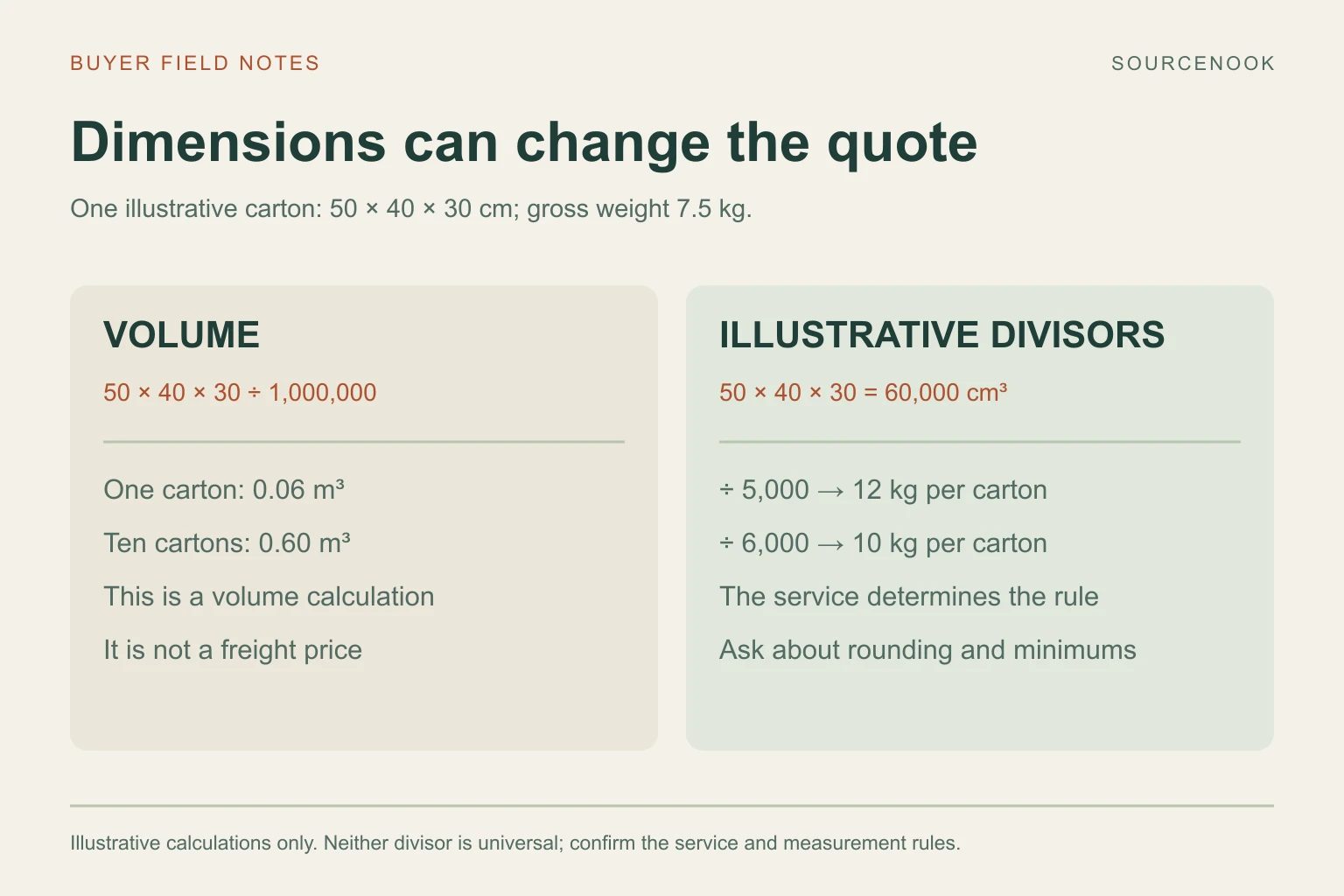
Using a service divisor of 5,000 cm³/kg, our example carton has dimensional weight of 50 × 40 × 30 ÷ 5,000 = 12 kg. If that service compares gross and dimensional weight per carton and uses the greater figure, the basis would be 12 kg rather than the physical 7.50 kg, before any further rounding or service rules.
With a divisor of 6,000, the same dimensions produce 10 kg. The package did not change; the charging rule did. Record the divisor, rounding and per-package rules from the actual service offer beside the calculation.
Calculate a provisional dimensional weight before requesting freight, and ask the carrier to confirm the service rule. With the example divisor of 5,000 and a rule taking the greater weight, the basis is 12 kg rather than 7.50 kg: 60% higher as a weight measurement. The freight price still depends on the rate, minimum charge, rounding and shipment rules. If the supplier proposes smaller packaging, obtain revised dimensions and a new service quote while checking that the goods remain adequately protected.
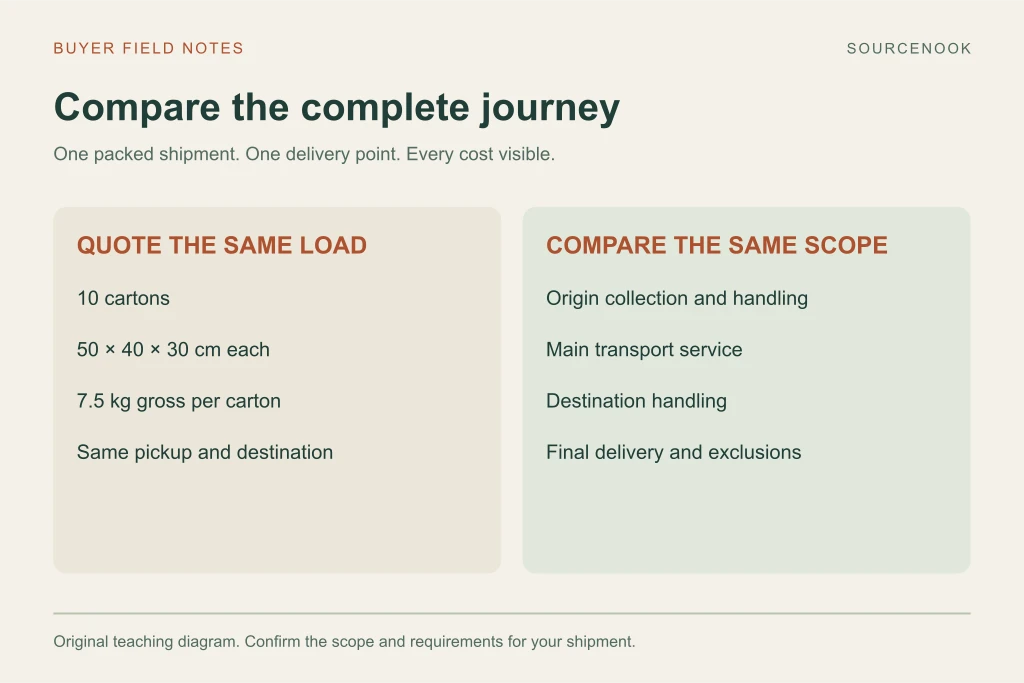
Once you have the billing basis, compare the services and exclusions in the quote. Our Alibaba shipping-cost example separates that weight calculation from origin handling, main transport and final delivery charges.
Ask suppliers for a packing breakdown
Use a request such as: “Please provide the number of cartons, units per carton, net and gross weight per carton, and external length × width × height with units. Please identify any different carton sizes and whether a pallet or additional wrapping will be used.”
Ask whether the figures are estimated or measured from final packaging. Early estimates can support a budget, but make that status visible. If the packaging design changes, request updated measurements before treating the freight estimate as current.
For mixed goods, request one line for each package type. Multiplying the largest carton’s dimensions by the total number of cartons can overstate volume; using the smallest can understate it. A readable packing breakdown also helps you compare the received quantity with the order.
A filled packing-data request
Example packing request for supplier confirmation
Product: fabric organizer. Package type: carton A. Count: 10 cartons, 20 units each, 200 units total. Per carton: net weight 6.00 kg; gross weight 7.50 kg; external dimensions 50 × 40 × 30 cm. Total: 60.00 kg net, 75.00 kg gross and 0.600 m³. Pallets: not included.
Supplier: please confirm whether these are estimates or final measurements, the packing version and the measurement date. If the actual carton types differ, replace this example with one line per type. Please confirm whether any extra wrapping or pallet will be added before handover.
If a forwarder combines goods or repacks them, the final external dimensions and gross weight may change. Request the revised packing breakdown before comparing the final transport offer. The warehouse cost example shows why China-side handover and overseas delivery must remain distinct.
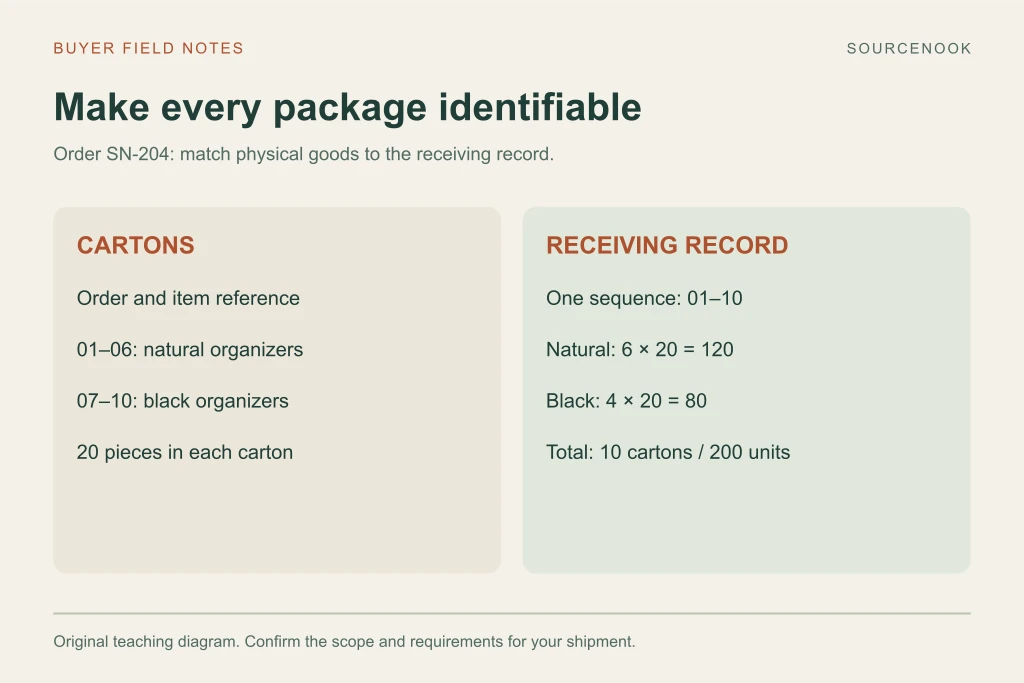
Connect each packing-list row to the physical carton and pallet shipping marks. If the shipment has two product variants, retain their carton ranges rather than presenting only one total weight; receiving needs to identify which goods are in each package.
Avoid the common spreadsheet mistakes
Keep kilograms and pounds in separate labeled fields until converted consistently. Do the same for centimeters and inches. A dimension written only as “50 × 40 × 30” is incomplete. Cubic meters are volume, not weight, and should not appear in a kilogram total.
Check whether packaging has already been included before adding it again. Match totals against units per carton and carton count. If the numbers do not reconcile, ask for clarification instead of adjusting them to make the sheet balance.
Finally, a charging weight does not state the full freight price or delivery scope. Record the service, named delivery point and exclusions alongside the measurements. Our inquiry guide shows how to request that scope, while the first-order guide places it in the wider buying process.
When packaging changes the comparison
A ceramic mug shipment adds protective inserts; a flat-pack table uses a different carton from an assembled table. Request final outer measurements for each packing version. Compare the packaging protection and transport quote together before accepting a smaller carton purely for a lower dimensional weight.
For pallets, obtain the final loaded dimensions including overhang and wrapping. Keep each different package type on its own line, then reconcile the units and gross weights with the shipment total.
Frequently asked questions
Is gross weight the same as volumetric weight?
No. Gross weight is the physical packed weight in the stated scope. Volumetric weight is calculated from dimensions using a service’s rule. In the example above, 7.50 kg gross and 12 kg dimensional weight describe the same carton under different measurements; they do not total 19.50 kg of cargo.
Can I calculate freight from product weight alone?
Use the final packed weight and external dimensions, package count, route and service. A net product weight can help check the packing record; the carrier needs the packed shipment details to calculate its charging basis.
Method. Carton measurements and calculations are constructed examples. The carrier’s service rules determine chargeable weight. Examples and diagrams are constructed teaching material, rather than supplier quotations or completed purchases. Reviewed September 16, 2026.