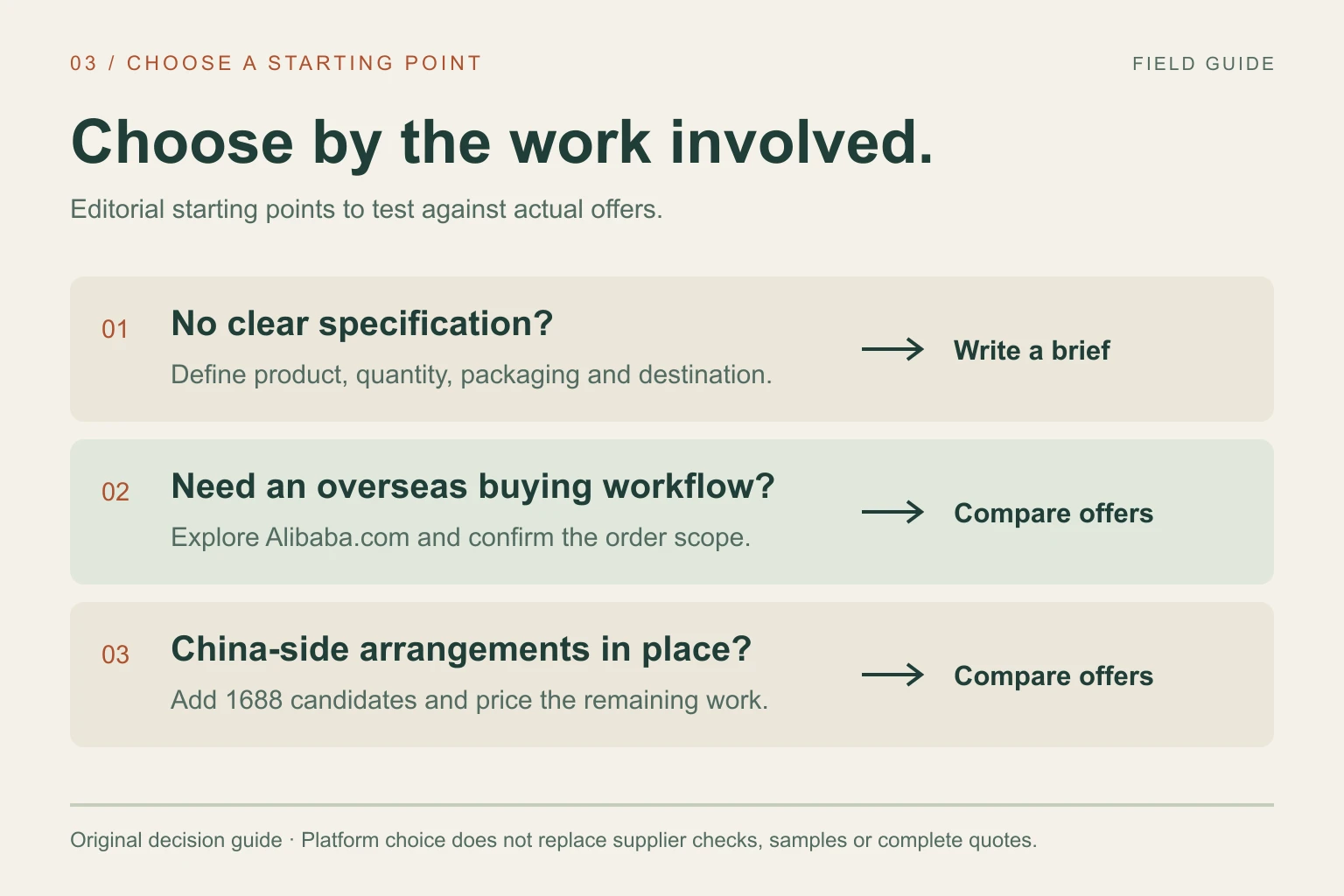
For a first overseas business order, start with Alibaba.com. Its international buying workflow makes it the more practical place to prepare a brief, contact suppliers and organize a sample. Add 1688 when you can arrange Chinese communication, payment, receiving and onward transport.
In the example below, a US$60 difference in goods cost shrinks to US$5 after packing, receiving and payment costs. One extra US$12 service then reverses the result. Compare the complete route before treating a lower product price as a saving.
1688 vs Alibaba: the practical difference
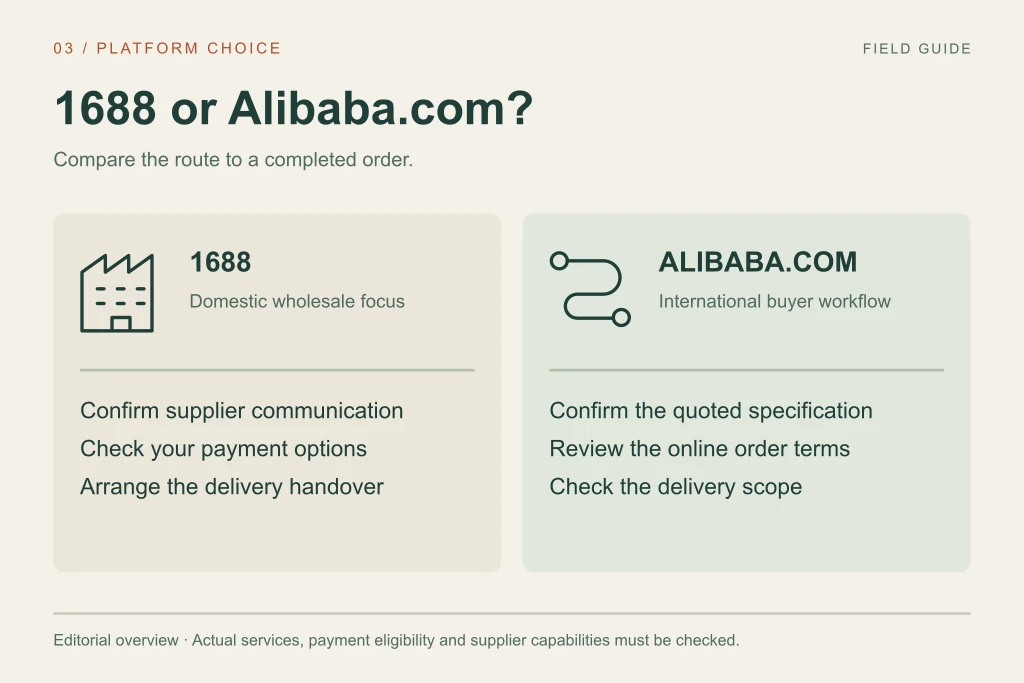
Alibaba.com serves international business buyers. Alibaba Group describes 1688 as a domestic wholesale marketplace. Both have a B2B/wholesale orientation; a low minimum quantity is compatible with that business model.
Use Alibaba.com’s buyer workflow to understand its sourcing steps. For 1688, confirm the communication, payment and China-side handover arrangements available to your account and chosen seller.
For each route, confirm three things before pricing: who can supply the exact product, how your account can pay, and who receives and checks the shipment. Keep color and packaging minimums in the brief. A low advertised quantity is useful only when it applies to that specification.
Is 1688 cheaper than Alibaba?
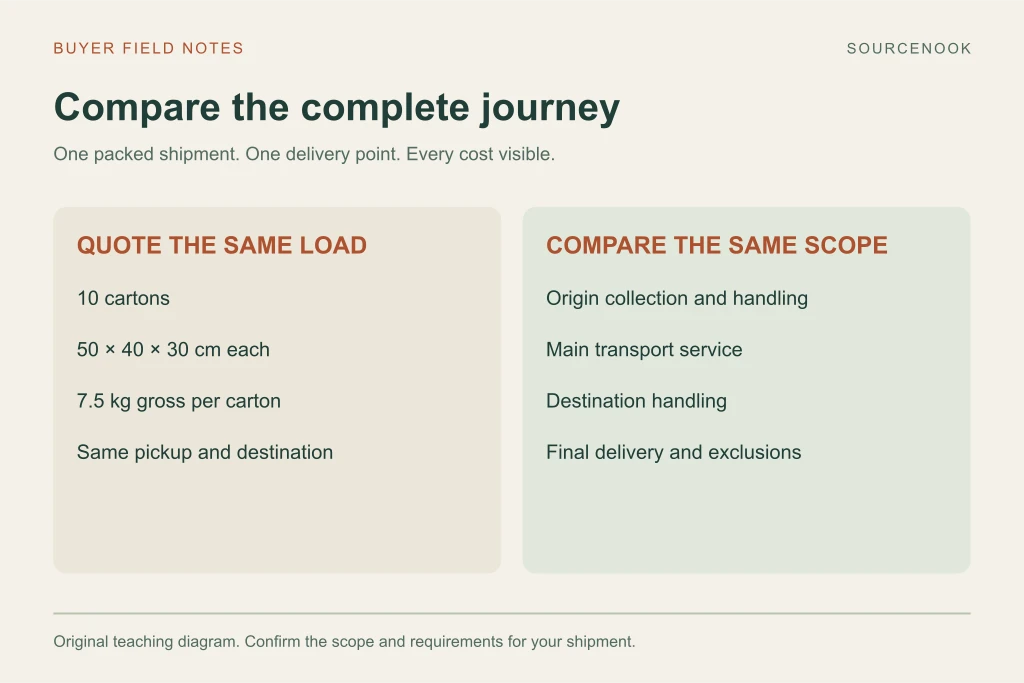
Compare the same material, construction, quantity, packaging and delivery point. Then add any separate coordination, inspection, payment and transport fees. The worked CNY comparison shows how the lower product price can become the higher total.
A 200-bag order, compared at one China warehouse
Example. A buyer needs 200 cotton tote bags: 38 × 42 cm, 180 g/m² fabric, one natural color and individual paper bands. Both candidates accept 200 pieces of that specification. Compare the two routes after the bags have been delivered to the same China warehouse and the same receiving check has been completed.
The figures below are teaching inputs expressed in USD. The service charges belong to the arrangements chosen for this example; they are not published fees charged by either marketplace. For real CNY and USD offers, retain the original currencies, use one dated conversion basis and list payment/conversion charges separately.
| Cost to the agreed point | Route A: 1688 candidate | Route B: Alibaba.com candidate |
|---|---|---|
| Goods | 200 × $1.20 = $240 | 200 × $1.50 = $300 |
| Paper bands and cartons | $30 | Included in goods price |
| Delivery to the same warehouse | $20 | $20 |
| Coordination and agreed receiving check | $30 | $10 |
| Payment/conversion service cost | $10 | $5 |
| Total to the agreed point | $330 | $335 |
| Cost per ordered bag at that point | $1.65 | $1.675 (about $1.68) |
Route A totals 240 + 30 + 20 + 30 + 10 = US$330. Route B totals 300 + 20 + 10 + 5 = US$335. A saves US$60 on the goods, but its other listed costs are US$55 higher. Its advantage is therefore US$5 for the order, or US$0.025 per bag.
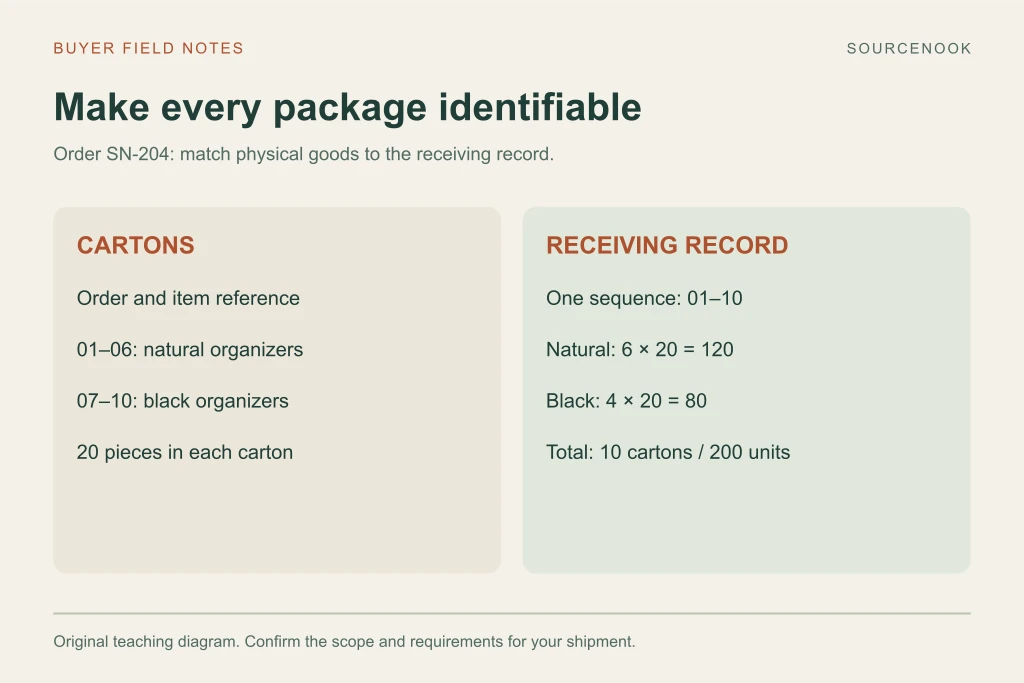
The receiving check must have the same scope in both offers: count the cartons and units, record visible packing damage and photograph the specified label. In this scenario A needs separately priced coordination while B fits an existing receiving arrangement. Price the work your own setup requires instead of copying either fee.
Find the cost that changes the decision
Suppose the warehouse later identifies a required labeling step for A at US$12, while B already meets that same label requirement. A becomes US$342 versus B’s US$335: B is US$7 lower. A’s break-even allowance for additional route-specific costs was only US$5; at exactly US$5 the routes tie, and above it the price advantage moves to B.
Before selecting A, close any unpriced job that could use up that US$5 margin. If both routes meet the product and schedule requirements and all costs are confirmed, A has a small cost advantage. If A still needs paid coordination or rework, resolve and price that work first. Keep the quote comparison at order-total precision and round only for display.
The calculation ends at the warehouse. Samples, production inspection, international freight, import charges and final delivery still belong in the buying budget. Price those on both routes before making an overseas-delivered comparison. Record work already completed as sunk cost separately from cash still needed for either choice.
If you already have a reliable buying route, we would not switch solely for the US$5 advantage in this example. Compare the work and cost of establishing the alternative route with that saving. If both routes are new, price their setup on the same basis; if a suitable China-side receiving arrangement already exists, include the costs that actually apply. Recalculate when quantity or services change, because the US$5 gap belongs to this order and need not scale proportionally.
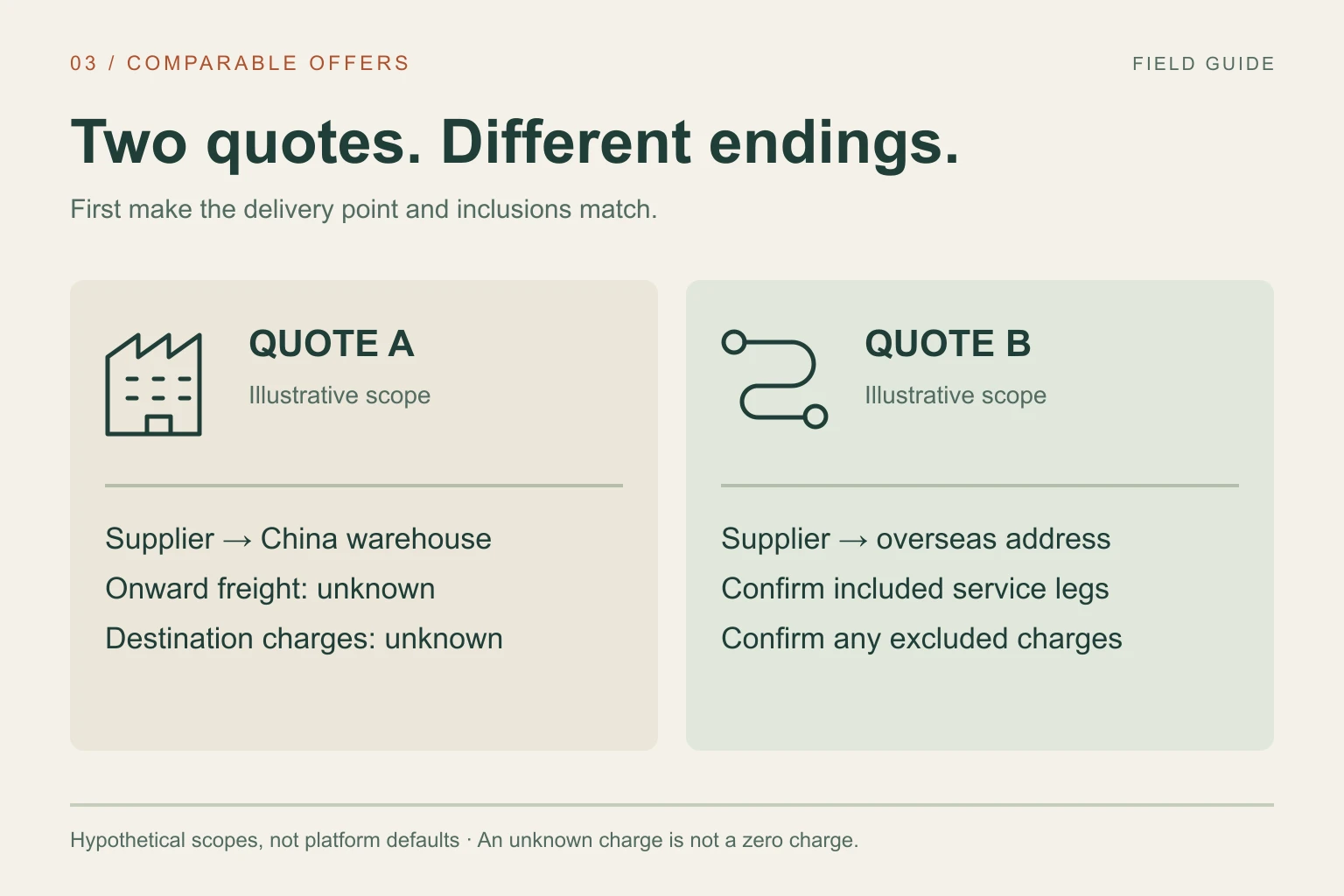
What if the starting quotes end in different places?
If A ends at a China warehouse but B includes delivery to your overseas address, request B’s quote to that same warehouse or obtain A’s onward costs to the same overseas address. Confirm packing and receiving services on both. Keep the two delivery scopes visible until those missing amounts are supplied.
Put EXW, FCA, FOB or DDP beside a named place
The ICC Incoterms rules define delivery responsibilities, costs and risk allocation. Use the agreed rule, a precise named place or port, and “Incoterms 2020” in the quote. The marketplace name says little about that handover.
- EXW: goods are made available at the named place, with the buyer arranging collection and export formalities. Clarify loading and who can carry out the export work.
- FCA: the seller handles export clearance and delivers to the nominated carrier at the named place. At the seller’s premises delivery includes loading; at another named place, delivery occurs ready for unloading. See ICC Academy’s EXW/FCA comparison.
- FOB: delivery occurs when goods are on board the vessel at the named shipment port. It applies to sea and inland-waterway transport. For container handover before vessel loading, examine FCA using the FCA/FOB comparison.
- DDP: the seller takes responsibility for import clearance and applicable import duties, delivering ready for unloading at the named destination. Check that the seller can perform those obligations in the destination country; ICC Academy discusses this in its DAP/DDP comparison.
Have a vague “shipping included” offer rewritten with the named destination and included charges. Obtain carton dimensions and packed weights for any onward leg your team arranges.
Check payment access before committing to a route
WorldFirst describes payment options for 1688 in its regional payment guide. Confirm eligibility, supported sellers and fees in your own account before building the order around that service.
For Alibaba.com, check the actual order’s supported payment options. If using Trade Assurance, retain the agreed specification and payment record in its supported order process.
Which platform should you investigate first?
| Your situation | A reasonable first step | What must be confirmed? |
|---|---|---|
| First overseas trial order | Start with Alibaba.com’s buyer workflow and a clearly specified sample inquiry. | Supplier fit, total quote, payment process and delivery scope |
| An established China receiving or consolidation setup | Add 1688 candidates to your existing comparison. | Exact product match, domestic handover and onward transport cost |
| A custom design or packaging brief | Compare capable candidates on both platforms. | Development responsibility, sample approvals, tooling and production minimums |
| Several unrelated products | Compare a coordinator’s scope with managing separate suppliers. | Who consolidates, checks quantities, repacks and resolves discrepancies |
| No defined product specification yet | Prepare the specification before choosing a marketplace. | Material, dimensions, quantity, intended use and destination |
Send the same product brief to shortlisted candidates. Judge communication by resolved details: product version, exclusions, sample process and schedule. Record sample approval, production start, dispatch and arrival as separate milestones.
Frequently asked questions
Do I need an agent for 1688?
List the work first: communication, payment, supplier checks, receiving, inspection and transport. Assign the tasks your team can perform and obtain a written service scope and fee for the rest. An established China receiving setup makes adding 1688 easier to evaluate.
Does Alibaba.com only list factories?
Its buyer workflow includes manufacturers, wholesalers and distributors. Ask each company what it makes and what it sources, then follow the supplier evidence checklist.
Which is better for a small order?
Compare minimums for the exact variant, color, branding and packaging. Use the MOQ negotiation method to distinguish a standard-stock trial from a custom production run.
Method. The recommendation compares buying workflows. The quantities, prices and service costs are constructed teaching inputs, not supplier quotations, marketplace fee schedules or measured savings between platforms. Diagrams explain the buying workflow. Reviewed September 15, 2026.