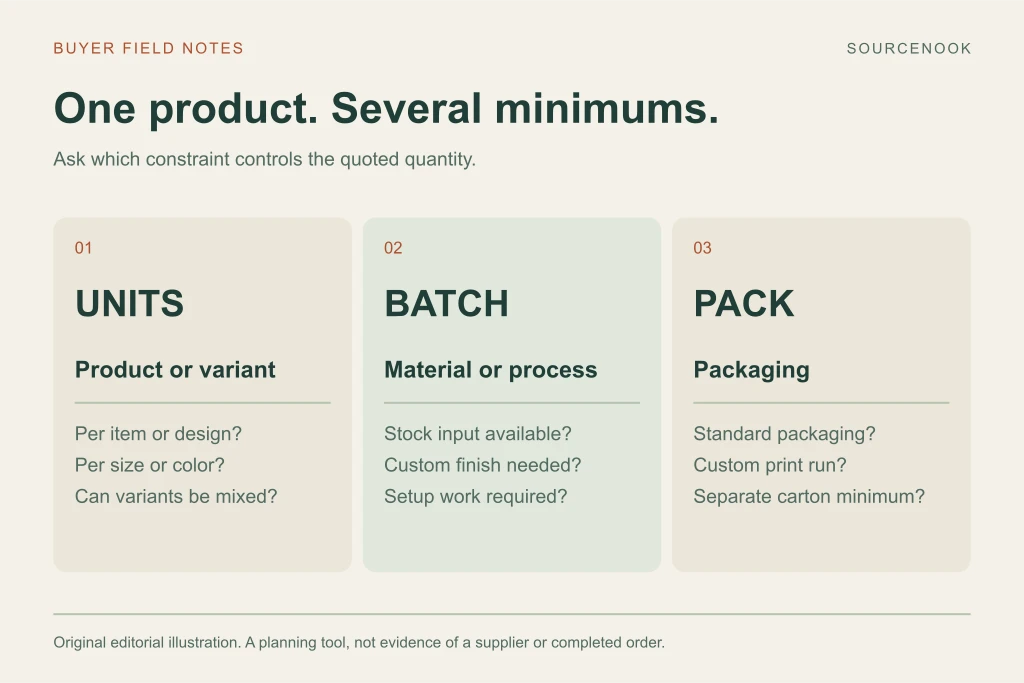
MOQ means minimum order quantity: the smallest quantity a supplier agrees to supply for a specified order. On Alibaba, confirm the minimum for the exact product, color, logo and packaging you want.
Negotiate by identifying what creates the minimum, then compare a smaller run with a simpler specification or separate setup fee. For a trial order, the useful result is a quantity you can sell and fund.
What is MOQ on Alibaba, and what does it apply to?
A product minimum and a box-printing minimum can be different. Ask for each threshold separately. Alibaba.com’s MOQ and Ready to Ship explanation gives the basic quantity concept; your quotation should confirm the chosen variant.
| Possible scope | Question to ask | Option to explore |
|---|---|---|
| Product or style | Is this minimum for one construction? | Use an existing standard model |
| Color or material | Does each material or color need a separate run? | Reduce the number of variants |
| Logo or artwork | Is there a setup minimum per design? | Compare a standard item with separate branding options |
| Packaging | Is the box minimum different from the product minimum? | Request standard packaging as a separate quote |
| Total order | Can eligible variants be combined, and on what terms? | Request a written mixed-variant quotation |
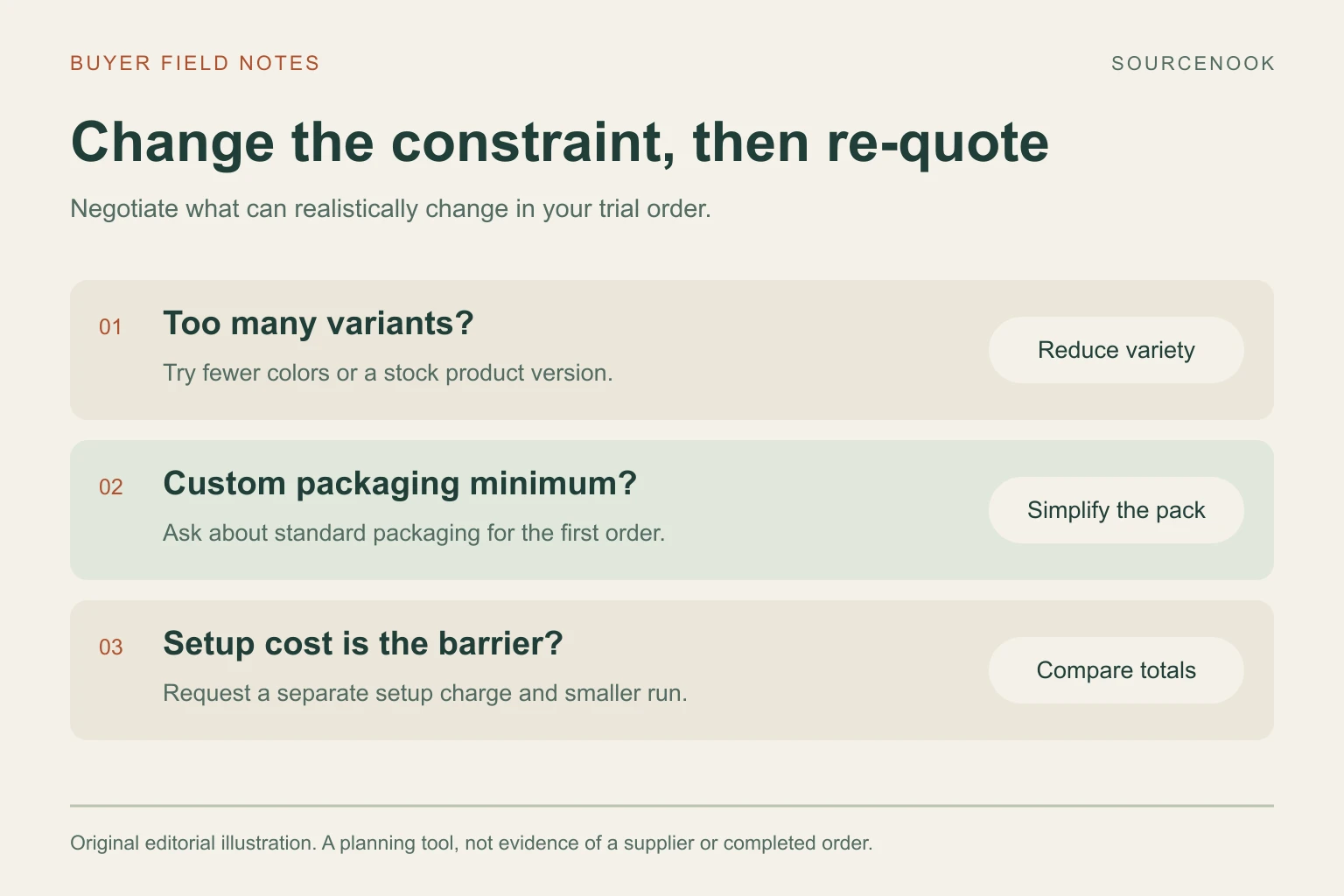
How to negotiate MOQ: three replies and three next steps
Example. You need 120 fabric organizers, but the first quote requires 300 per color. Ask: “Which part of our specification creates the 300-unit minimum?”
- “The custom fabric requires 300.” Request a 120-unit option using available fabric. Compare composition, color and construction with your original brief before choosing it.
- “The box printer needs 300.” Request standard sleeves and cartons. Have the supplier remove the custom-box cost from the revised offer and identify the replacement packaging.
- “We can make 120 with a separate setup fee.” Ask for the fee, unit price and exact included work. Compare total cash required using the calculation below.
If every smaller option removes an essential feature, close that branch and try another supplier. Record why the order failed to fit; that information makes the next inquiry more precise.
US$660 or US$1,260: calculate the commitment
| Item | Option A: smaller run | Option B: higher MOQ |
|---|---|---|
| Units ordered | 120 | 300 |
| Unit price | US$5.00 | US$4.20 |
| Product subtotal | US$600 | US$1,260 |
| Separate setup charge | US$60 | US$0 in this example |
| Known subtotal | US$660 | US$1,260 |
| Units beyond initial test need | 0 | 180 |
| Freight and destination costs | Not yet quoted | Not yet quoted |
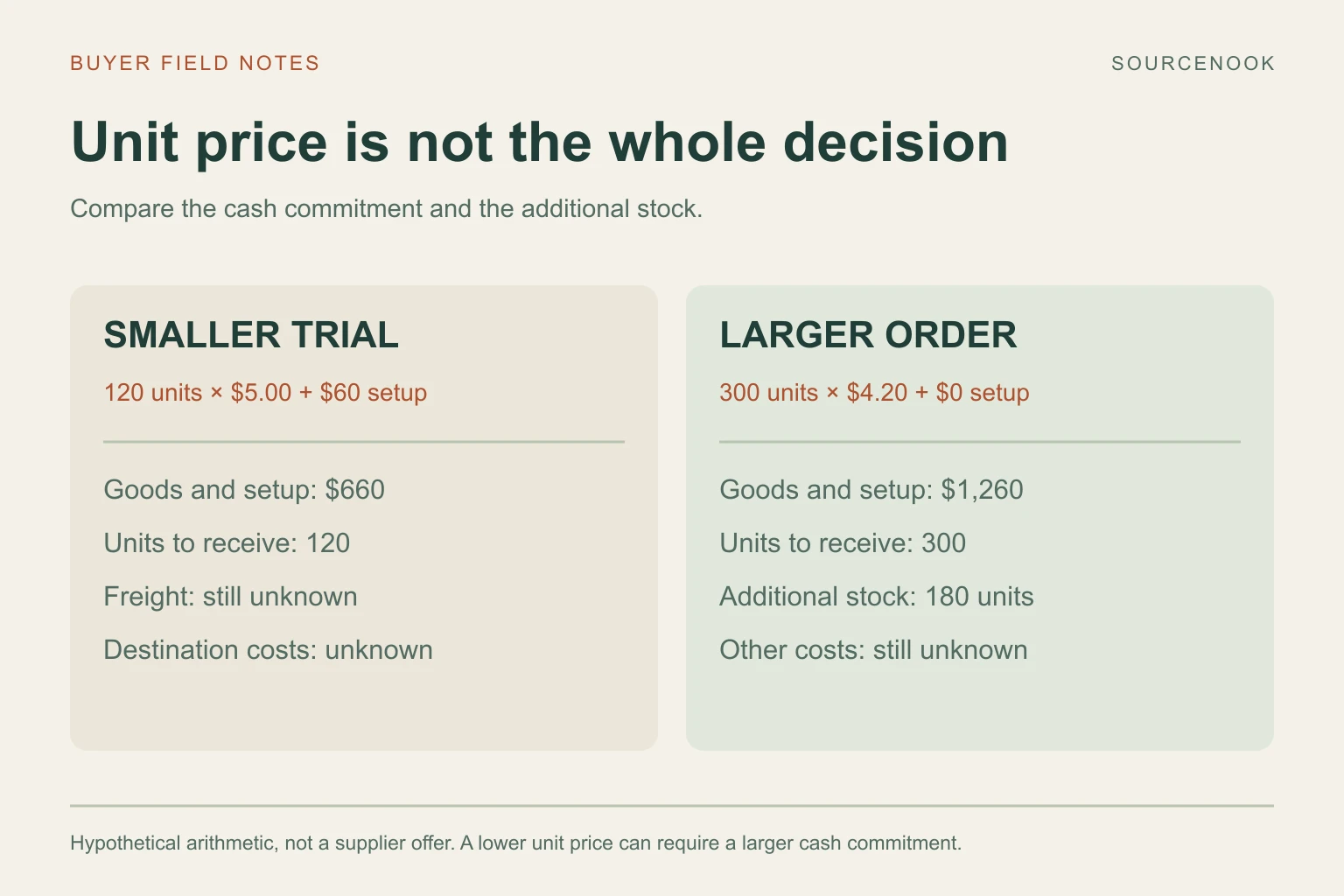
The smaller run costs 120 × US$5.00 + US$60 = US$660. The larger run costs 300 × US$4.20 = US$1,260. Taking the lower unit price commits US$600 more and leaves 180 units beyond the initial test need.
Choose the larger run only when there is a credible use for the extra stock and enough cash for its transport and storage. For an uncertain product test, the smaller run preserves money for learning and a revised order.
For the two options in this example, we favor the 120-unit run when demand is untested and that quantity fits the trial budget. The US$60 setup charge limits the initial production commitment to US$660 and leaves US$600 available for later decisions. Approve the material, size and other critical features through sampling first; use the production trial to learn about customer demand. Choose the actual trial quantity from your budget and selling plan rather than treating 120 as a general minimum.
Different products create different minimums
For a metal desk lamp, separate the standard body from a new finish, custom component and printed retail box. Request a standard-finish offer alongside the custom-finish offer. Keep the selected electrical configuration fixed while comparing those cosmetic changes.
For a wooden side table, separate the existing size and finish from new dimensions or fittings. Ask the supplier to name the setup work for each change. The design responsibility guide helps distinguish a catalog variation from a development project.
Send a focused negotiation message
Our trial requirement is 120 units in one color. Your minimum is 300. Please identify whether the constraint comes from the product, material, component or packaging. Quote any feasible 120-unit option separately, with its setup cost, specification changes and production schedule.
Use the RFQ template to retain the original and revised offers. Ask when production timing starts: for example, after material confirmation or sample approval. Record the start condition, working or calendar days, and dispatch milestone.
Check the revised offer before accepting the smaller run
Compare the revision with the original brief field by field: material, construction, color split, logo, packaging, quantity, setup charges and dispatch commitment. Mark each change as accepted or awaiting a decision. Request a sample of any changed feature that matters to the product test.
Suppose the supplier accepts 120 organizers but changes the fabric and removes the paper sleeve. If the sleeve is optional for your trial, accept that change explicitly and obtain the revised packing cost. If the fabric is central to the product you want to test, keep its approval open until you evaluate the proposed replacement. The lower quantity alone leaves that product decision unresolved.
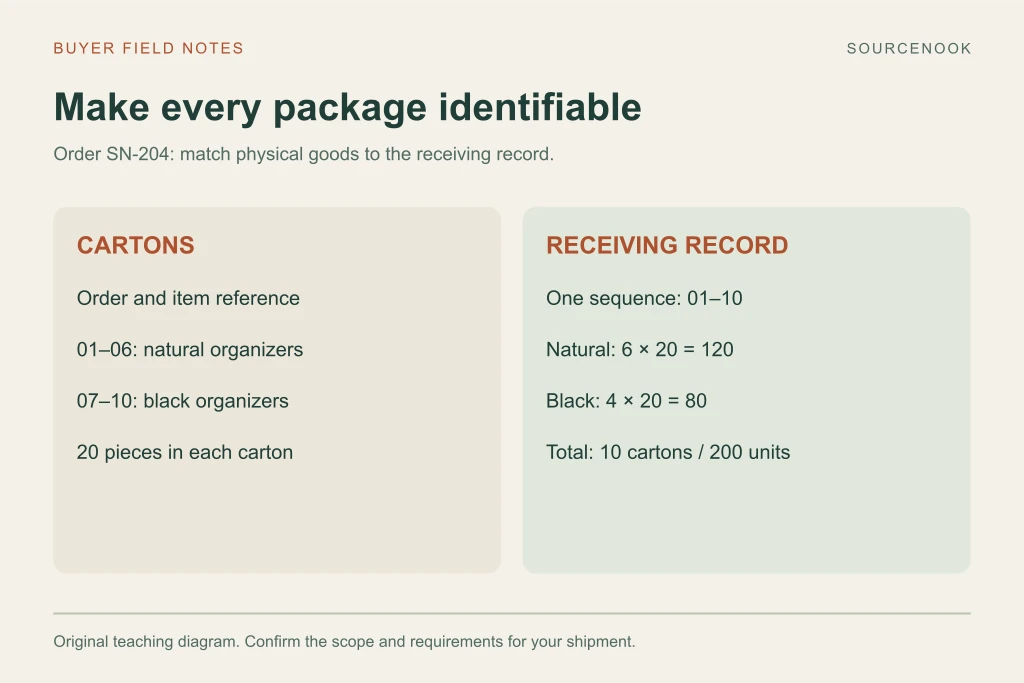
A reply saying “120 total” also needs the intended color split. Have the supplier confirm 60 natural plus 60 black when that is your request. If the minimum is 120 per color, the offer commits you to 240 units; return it for a one-color or revised mixed-color option before accepting.
Accept the revised quantity when the version, total commitment and remaining sample work are clear. If an essential feature is lost, change the sourcing option or defer the trial. Save the accepted quote version so the production order uses the negotiated specification.
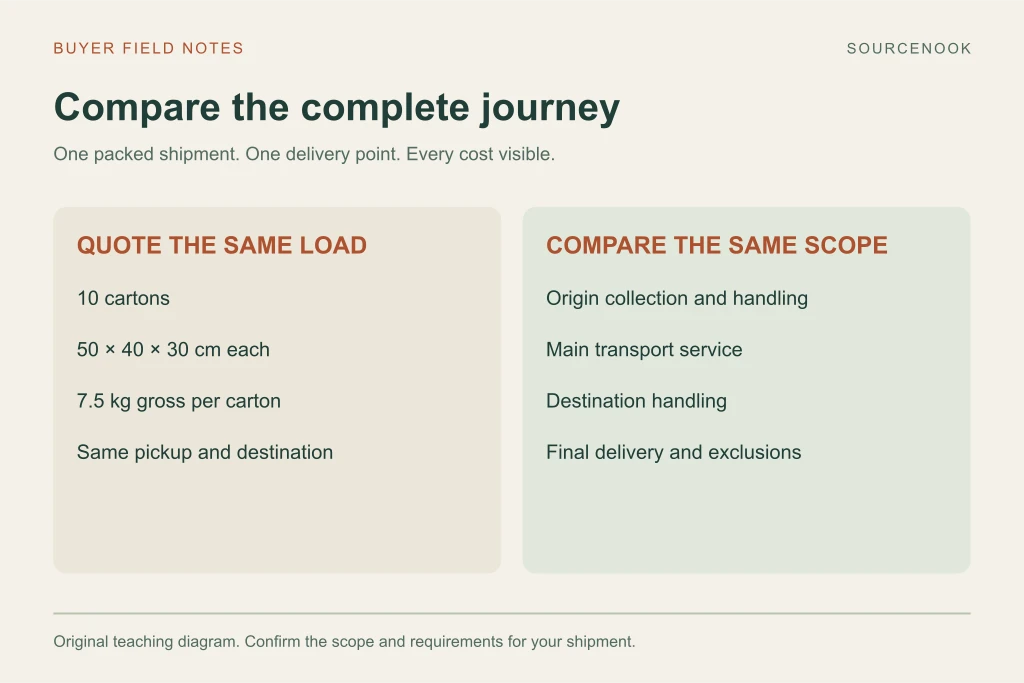
Before accepting the larger run, ask for its carton count and dimensions as well as the smaller-run packing plan. Compare shipping charges at the same destination. A lower unit price can still require more cash for both inventory and transport.
Frequently asked questions
Can I order one sample below the MOQ?
A supplier may offer a single stock item for evaluation while requiring a larger customized production run. Confirm the sample type and the features it represents using the sample request and review sheet.
Can I mix colors to reach the minimum?
Request the minimum per color and the total. Write the intended split, such as 60 natural plus 60 black, and obtain a quote for that combination. If each color requires a separate material run, compare one color first.
Should I promise a bigger repeat order?
State the actual trial and describe a repeat as conditional on results. A repeat-order price tier can be useful for planning; keep it separate from the quantity you are committing to now.
Method. The quantity and cost scenarios explain negotiation choices; prices are example inputs. Examples and diagrams are constructed teaching material, rather than supplier quotations or completed purchases. Reviewed September 16, 2026.