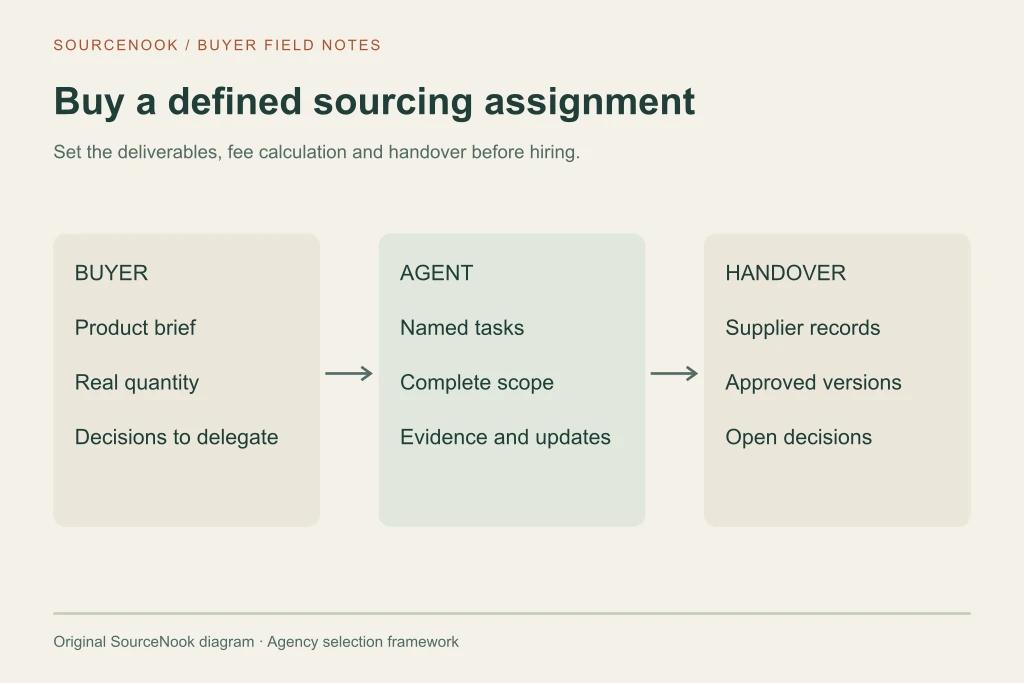
Choose a sourcing agent by the work they will deliver for your order: a qualified shortlist, comparable quotations, sample coordination, production follow-up or a combination of those tasks. Ask each candidate to quote the same assignment and explain how they are paid by both you and suppliers. A low headline fee is useful only when it buys the work you need.
You can make the first conversation concrete with three things: a product brief, a real trial quantity and a list of decisions you want help making. That lets a product sourcing agent explain their fit and gives you a way to compare proposals.
What do you need the agent to take off your desk?
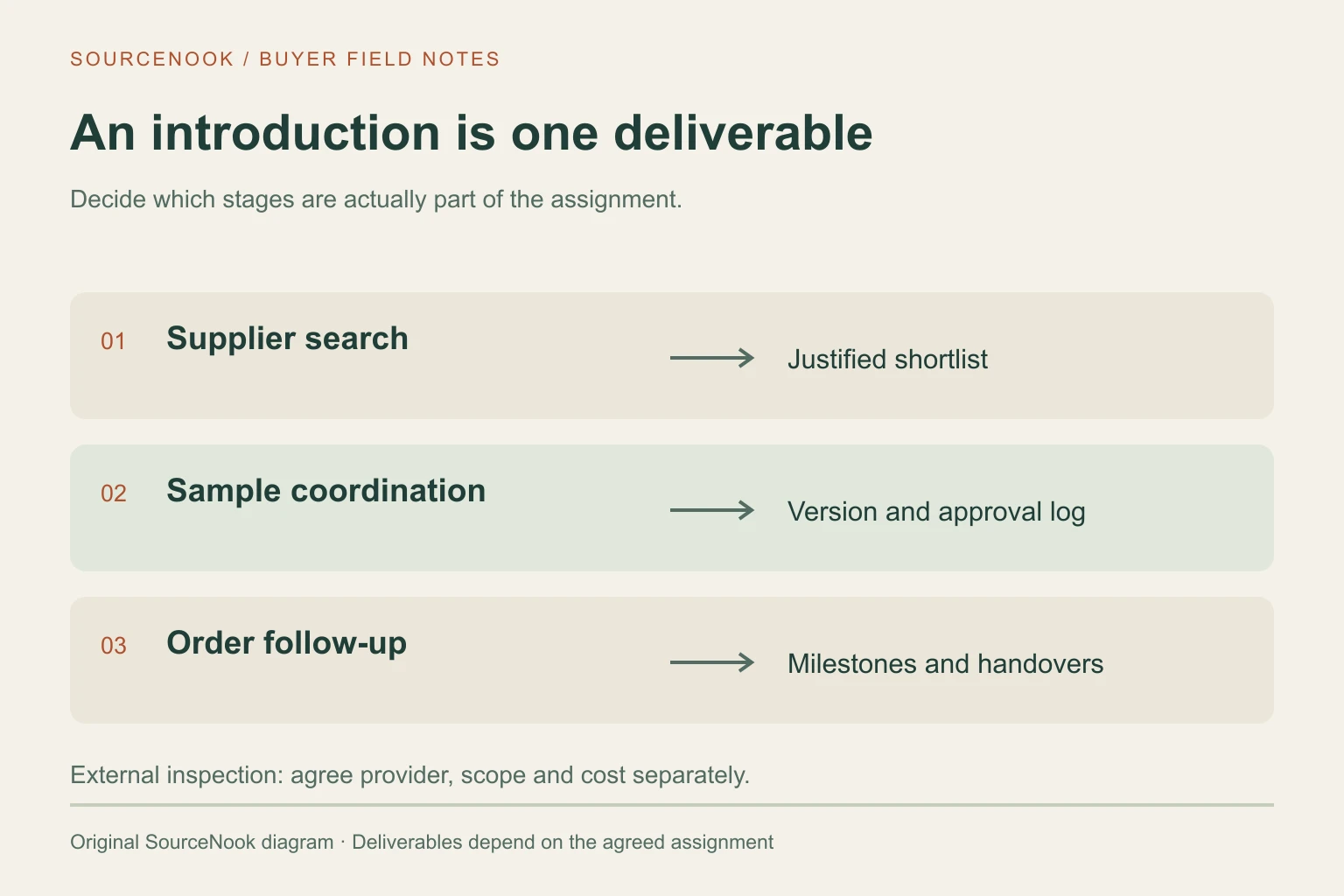
A supplier introduction and management of a purchase are different assignments. If you already have a suitable factory, paying for a new search may solve the wrong problem. If you have no workable specification, sending more inquiries will multiply inconsistent quotations.
| Your bottleneck | Work to request | Deliverable to review |
|---|---|---|
| Finding suitable candidates | Search against the product and process brief | Shortlist explaining capability, minimums, exclusions and unanswered questions |
| Incomparable quotations | Resolve missing lines and substitutions | Comparison with quote references and a shared delivery boundary |
| Sample coordination | Track versions, questions and approvals | Sample log, agreed corrections and remaining tests |
| Several suppliers on one order | Coordinate production and handovers | Named responsibilities, milestone updates and consolidation requirements |
| Factory or product uncertainty | Arrange a defined assessment or inspection | Named provider, scope, cost and report; specialist work priced explicitly |
For a brand ordering pet beds and separately printed cartons, coordination means more than sending messages. Someone must confirm the final bed size, get the carton supplier the packed dimensions, approve the label file and match quantities at handover. An agent who manages that sequence may be useful even when you found both suppliers yourself.
Write the assignment around outputs you can inspect. “Full service” leaves room for different expectations; “maintain the sample log and obtain our written approval before releasing the carton artwork” identifies an action and its decision owner.
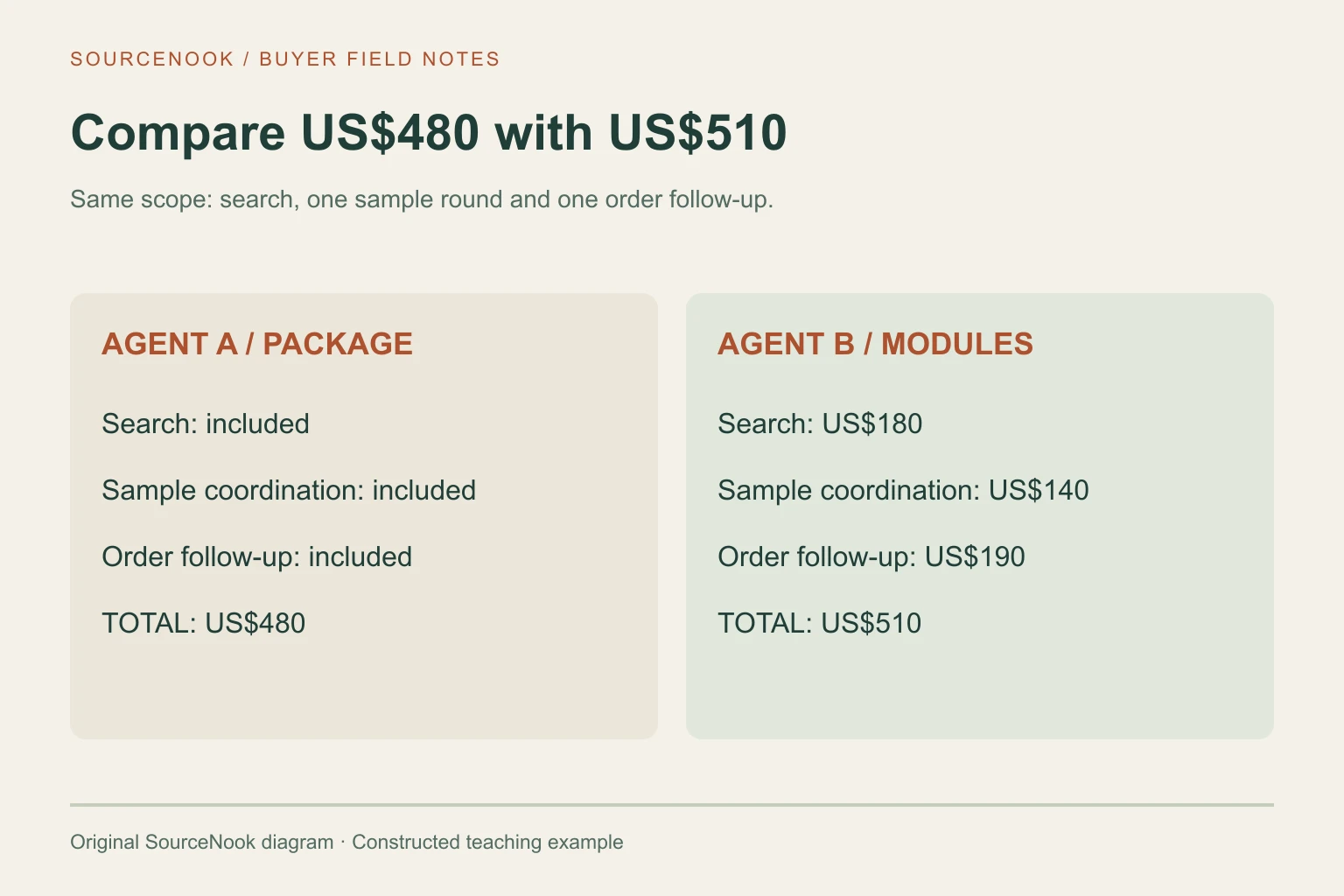
A US$180 proposal can cost more than a US$480 proposal
Example. A small brand wants a supplier shortlist, coordination of one agreed sample round and follow-up for one purchase order. Agent A offers those three tasks for US$480. Agent B quotes US$180 for the search, US$140 for sample coordination and US$190 for purchase-order follow-up.
| Included work | Agent A | Agent B |
|---|---|---|
| Supplier search | Included in package | US$180 |
| One sample coordination round | Included in package | US$140 |
| One purchase-order follow-up | Included in package | US$190 |
| Agent fee for the assignment | US$480 | US$510 |
| Supplier samples, courier and external inspections | Excluded; quote separately | Excluded; quote separately |
B’s starting price is US$300 below A’s package, but the comparable assignment is US$30 more. That difference is small enough that a better product fit or clearer handover could justify B. The important discovery is that you are choosing between US$480 and US$510 for this work, not between US$480 and US$180.
If the same buyer already has a qualified supplier and needs only sample and order coordination, B’s stated modules total US$330. Ask A for a revised scope instead of buying an unnecessary search. We would favor the proposal that clearly owns the buyer’s actual bottleneck, then compare the complete price. Choosing by either headline fee or package size can lead to paying for the wrong work.
Make the fee calculation and supplier relationships visible
Sourcing agent fees can be quoted as a fixed assignment, separate stages, time-based work, an order-linked charge or a margin within the goods price. Obtain the calculation in writing. For an order-linked charge, define the base: goods only, packaging, freight, tooling and other services can produce very different totals. For time-based work, agree an approval limit and what the time record must show.
Ask whether the agent receives supplier commissions, referral payments or rebates, and how these affect the quoted service. Ask whether you can see underlying supplier quotations and which information will be shared. A reseller’s combined goods price may be workable, but compare it as a reseller offer; do not assume it is an independently disclosed factory price plus an agency fee.
Also establish who contracts with the manufacturer, who invoices you for goods, who receives payments and who handles a defect claim. If the agent is the seller, the commercial relationship differs from an agent coordinating your direct supplier contract. Keep those roles clear in the agreement before deciding how to pay.
Evaluate experience through a relevant piece of work
Ask for a redacted example of the output you are buying: a product brief, comparison or sample log. A useful example explains what was missing, what changed and who made the decision. A list of recognizable client logos provides less help in judging whether the agent can coordinate your particular product.
For a pet bed, discuss the removable cover, filling, seam construction, compressed packing and carton handover. For a bent-metal display stand, discuss the drawings, finishing and assembly tolerances. The agent should identify the operations they understand and explain where a factory engineer, test laboratory or inspector would be involved.
Company identity is another check. For a UK-registered company, the Companies House information service provides records such as registered address, officers and filing documents. Use the relevant official register for the stated jurisdiction and match the entity to the proposal. Treat the records as identity evidence; assess the proposed service through its scope and relevant work.
A bounded paid first assignment can make the choice easier to evaluate: one agreed sourcing brief, a shortlist with reasons and a defined quotation comparison. Decide what a satisfactory handover looks like before buying it. You can then choose whether to extend the relationship into samples or production based on the delivered work.
Questions to put in the proposal request
We need help with [specific tasks] for [product and quantity]. Please identify the person managing the work, the deliverables for each stage, your fee calculation and excluded costs. Explain any supplier-side compensation, who will contract and pay for goods, and which records we receive. Please state what happens if the search finds no suitable supplier, a sample needs revision, or we stop after the first stage.
Ask what triggers each stage and which decisions require your approval. If production follow-up means collecting progress updates, price inspection separately when you need physical checks. If an inspection is included, name the scope and provider. This prevents a status message from being mistaken for a completed quality review.
Use the supplier vetting workflow to define evidence gaps and the sample evaluation guide to specify approval records. For an Alibaba order, the RFQ template gives the agent a concrete starting brief.
Agree how the relationship ends or moves to a reorder
Before the first assignment, record what you receive at handover: quotations, approved specifications, sample references, relevant supplier contacts and the status of open work. Agree access to design and production files, any tooling arrangements and how future order fees are calculated. These are easier to settle before you depend on the agent for every update.
Choose a candidate when their scope covers the work, their pricing is understandable and their product experience matches the assignment. Clarify a proposal when a missing task can be priced and owned. Decline or narrow the engagement when essential records or responsibilities remain undisclosed. A long conversation is not progress if it never resolves who is responsible for the next commitment.
Frequently asked questions
Is a sourcing agent the same as a trading company?
An agent may coordinate a purchase between you and a supplier, while a trading company may sell the goods to you. Some businesses offer both arrangements. Ask which entity signs the goods contract, sets the goods price, receives payment and handles claims for your specific order.
Can I hire a sourcing agent after finding a manufacturer?
Yes, if they offer the coordination you need. Request a proposal for the remaining work, such as sampling, quote reconciliation or consolidation. Confirm whether the agent will work with your chosen supplier and what they need to review before accepting responsibility.
How much should I pay a sourcing company?
Start with comparable proposals for the same deliverables, order scope and exclusions. Calculate the complete assignment fee and separately budget samples, transport and specialist work. The worked comparison above shows why a low discovery fee is an unreliable substitute for that total.
Do I need an agent in the country where the factory is located?
Location matters when the job requires site visits, local coordination or language support. Establish who will perform those tasks and how they are priced. A remote coordinator may suit document and communication work; on-site work needs an identified person or provider.
Method. The agent proposals and pet-product assignment are constructed teaching examples, not market fee benchmarks or completed engagements. The selection criteria are SourceNook’s editorial recommendations; official company records are linked for the identity-check step. Reviewed September 16, 2026.