Find 1688 suppliers with a product-specific search, then check the business behind each useful listing. A shortlist is ready for sampling when the legal entity, production responsibility and quoted specification are consistent.
Keep a record for each candidate: listing, selected variant, legal company name, contact, quote version and next action. Investigate gaps before treating the candidate as ready.
Search by product and production detail
For canvas bags, start with 帆布袋 and refine by material, dimensions or printing. For a metal desk lamp, try 金属台灯 and refine by model features. Image search can help discover similar shapes; send the written specification to confirm material and components.
Keep shop display names separate from legal business names. If two storefronts identify the same company, record that relationship in the shortlist. Compare their offers separately while counting the underlying supply source accurately.
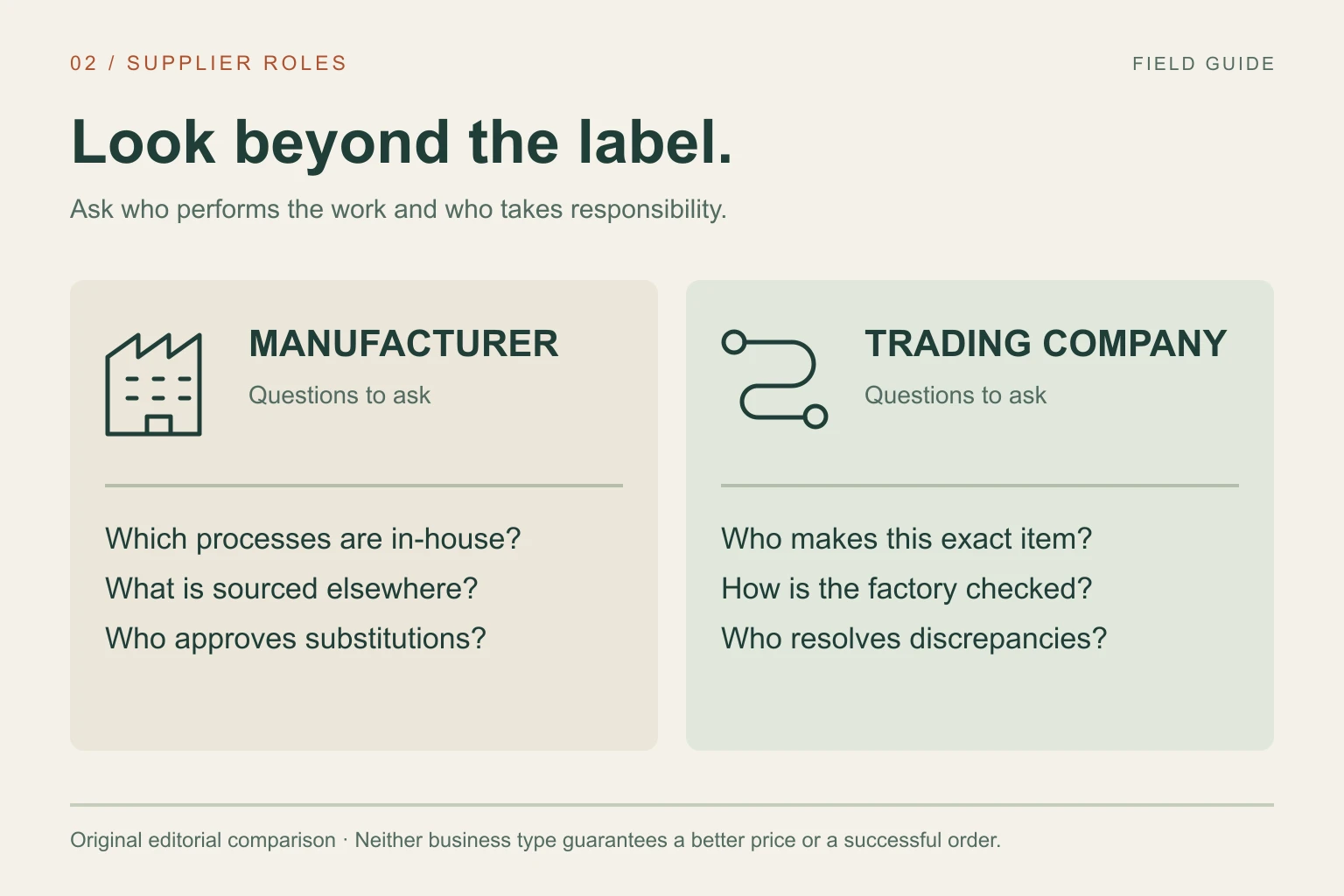
Factory or trading company: choose by the work required
| Your need | Question for a manufacturer | Question for a trading company |
|---|---|---|
| A custom product | Which processes are in-house, and which changes need new tooling? | Who manages the producing factory and approves design changes? |
| Several product types | Which items do you manufacture, and which do you source elsewhere? | How are different suppliers coordinated and inspected? |
| A small trial order | Can you supply the trial quantity with the specified material and finish? | Does the trial use the same production source as a repeat order? |
| Consistent repeat orders | How do you record the approved specification and control substitutions? | Will the production source remain the same, and how are changes disclosed? |
| Shipment coordination | Who prepares the agreed packaging and hands over the shipment? | What coordination is included, and what is billed separately? |
For a custom product, prioritize direct answers about the relevant production process. For a mixed-product order, a trading company may help coordinate several sources. In either case, identify who receives specification changes and who resolves defects.
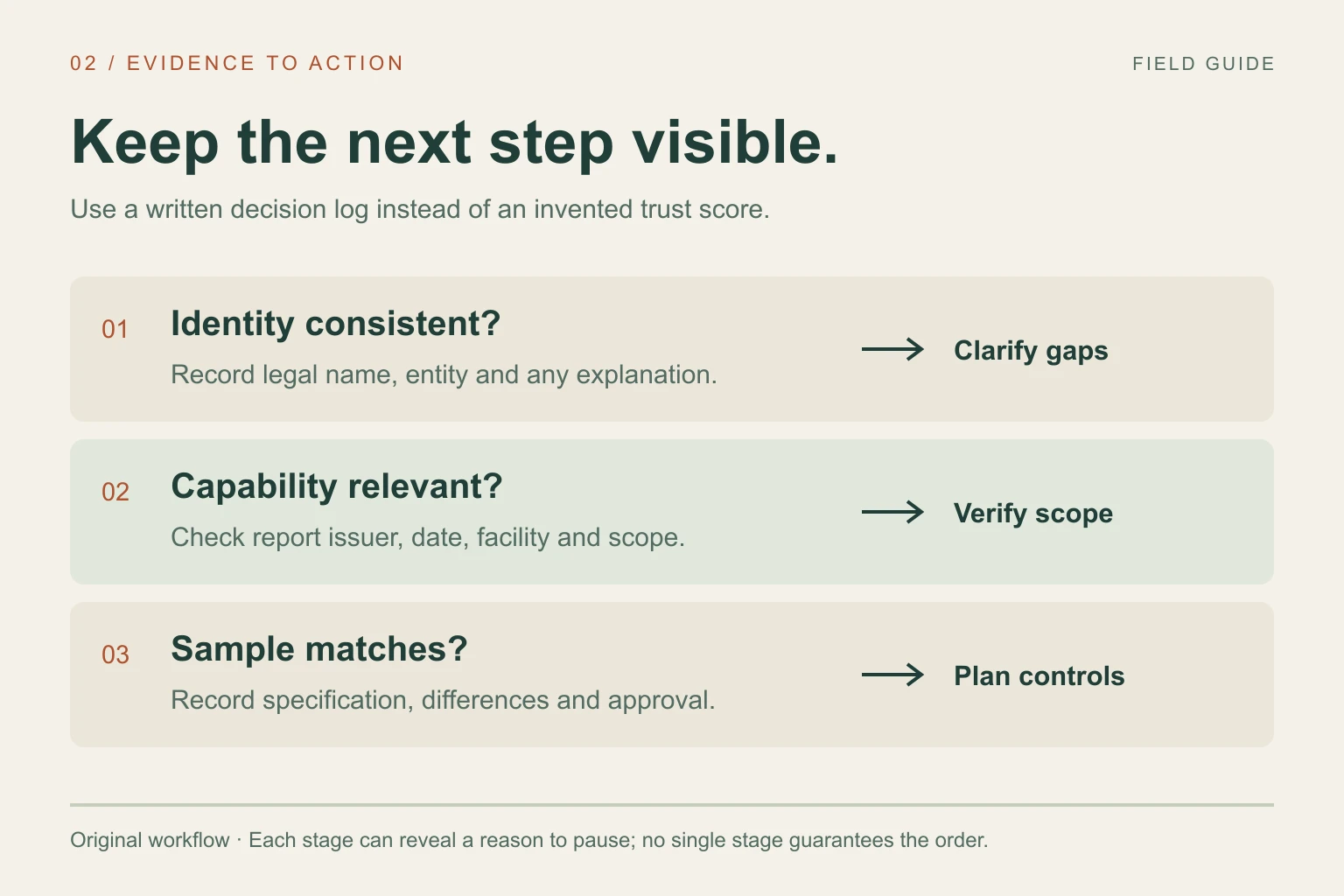
Keep identity, capability and product checks separate
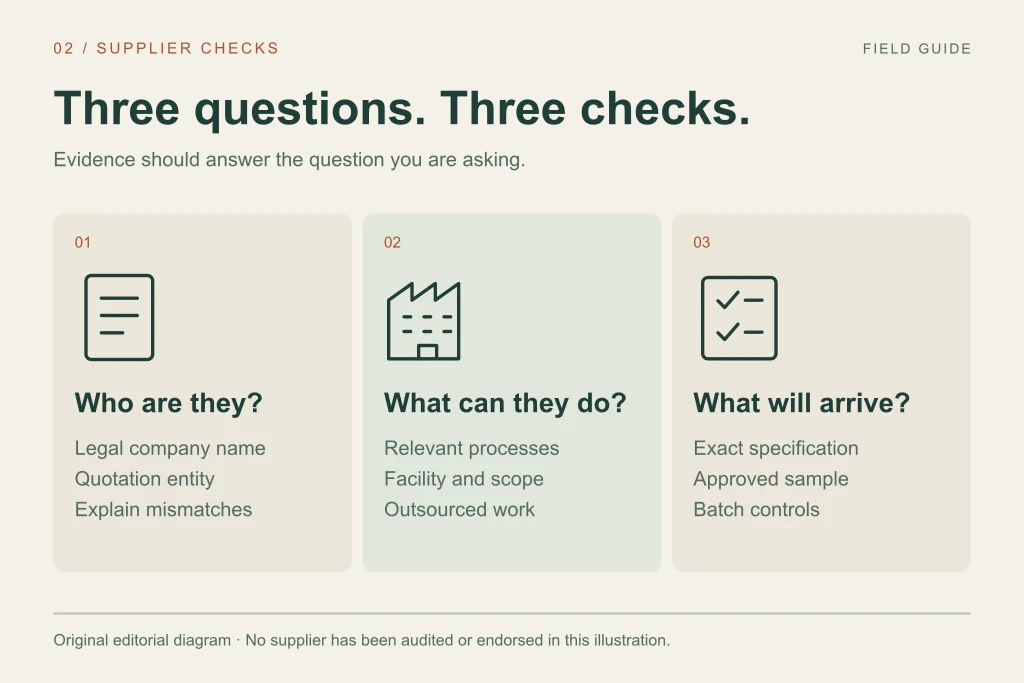
| Check | Evidence to request or examine | Decision or follow-up |
|---|---|---|
| Business identity | Legal name, registration identifier, address and the entity named on the quotation | Match the entity across the storefront and order |
| Supplier role | Written explanation of manufacturing, sourcing and outsourced operations | Identify the source for your specific item |
| Assessment report | Issuer, date, inspected entity, facility and scope; confirm questionable details with the issuer | Confirm coverage of the proposed production site |
| Product documentation | Exact model, applicant, issuer, date and the requirements covered | Match the exact model and intended destination |
| Sample | Sample ID, measurements, agreed tests, photos and recorded differences | Record approval and the production checking plan |
| Order responsibility | Named contracting party, specification version, delivery commitment and issue-handling process | Save agreed responsibilities in the order |
Use the official business registry or report issuer’s verification channel where available. Record the source, date and matching identifiers. If the company on the quote differs from the company behind the shop, request the relationship and supporting records.
A mismatch worth resolving
Example. A shop describes itself as a bag factory, but its quote names a trading company. Ask which company accepts the order, where the bags will be sewn and which party handles a defect claim. Proceed to sampling when the documented roles are consistent. Keep the candidate paused if those questions remain unanswered.
Apply the same method to a lamp seller. Ask who supplies the body and electrical components, who assembles the quoted model, and who checks the finished product. Match any facility assessment to those operations and the actual site.
If the proposed production site or a critical operation remains unverified, define that gap before commissioning an assessment. Give the reviewer the product brief and the exact site to examine; the facility assessment example shows how to set the scope and interpret the reply.
Use product evidence suited to the category
For tote bags, record dimensions, fabric, handles, seams and packaging against the agreed sample criteria. Keep the sample ID and photographs beside the specification; our sample review table shows how to document a size or seam failure.
For electrical goods intended for overseas sale, match the offered configuration to the supporting documents and arrange the relevant technical review. A document for another model leaves the quoted product unresolved. Use the product-document comparison to record that gap, and have a qualified specialist assess the requirements for the destination market.
Send a request the supplier can answer point by point
Please confirm the legal company accepting this order and the production address for specification A. Which operations do you perform there, and which are outsourced? Identify any relevant assessment by issuer, date, site and scope. Please confirm whether the sample will use the quoted fabric, handles, seams and paper band, and explain how we approve changes before production.
Keep the answer beside the quote and attach the referenced documents. Translate descriptive text as needed, while keeping company names, registration identifiers, model codes, dimensions and units unchanged in the record. Ask the contact to correct the exact field when a translated reply is ambiguous.
Read the answer for a next action
“We make bags and can do anything” leaves the production scope open. Reply with the missing operations and address. A reply that identifies the sewing site, explains outsourced printing and names the person approving artwork gives you concrete items to verify.
If a report covers a different site, ask for the relationship and evidence for the proposed production location. If the supplier sends the same unrelated report again, leave capability unresolved and move the inquiry to another candidate that can answer the requirement.
For an initial shortlist, our working limit is two clear follow-ups on an unanswered production-identity question. State the exact company or site information needed and check that the contact understands the request. If it remains unresolved, pause that candidate and spend the available research time elsewhere. This is a way to manage the shortlist, not a conclusion about the supplier’s motives; reconsider when verifiable information arrives.
Close the sample-to-order gap
Suppose the quote specifies cotton fabric and a printed paper band, but the sample arrives with a different fabric and no band. Record those as two separate discrepancies. Ask whether this is a declared stock sample or the intended production version. A stock sample can support the features it represents; keep fabric and band approval pending.
Request a corrected sample with a new ID and a list of changes. When it passes the agreed checks, reference that ID and specification version in the production order. Agree that proposed material, print or production-source changes need written approval before use. Keep a record of any new price or schedule resulting from the change.
Decide whether to proceed, clarify or pause
- Proceed to a sample: company roles and production arrangements are consistent, and the supplier confirms the specification.
- Clarify: a report date, scope, price line or sample feature is missing. Name the missing item and the person responsible for resolving it.
- Pause: an unexplained entity or payment change, unresolved model mismatch, or refusal to confirm an essential requirement blocks the next commitment.
After the checks, compare the completed quotes. If your team still needs payment, receiving or onward transport support, price those tasks using the platform comparison before choosing the route.
Frequently asked questions
Is 1688 a legitimate marketplace?
Alibaba Group identifies 1688 as its domestic wholesale marketplace. Assess the individual seller and the proposed order using the checks above.
Does an Alibaba.com assessment explain a 1688 badge?
Read the explanation attached to the specific 1688 badge or report. Record its issuer, date and scope. The Alibaba.com Verified Supplier guide describes a separate platform program.
Method. The checklist and company/model mismatches are editorial examples; SourceNook has not audited or endorsed the candidates described. Examples and diagrams are constructed teaching material, rather than supplier quotations or completed purchases. Reviewed September 15, 2026.